Project service
Cosmetic Product Safety Report (CPSR).
The mandatory safety assessment for your product, prepared by CIGREG and signed by a qualified safety assessor.
What the law requires
A safety report signed by a qualified assessor.
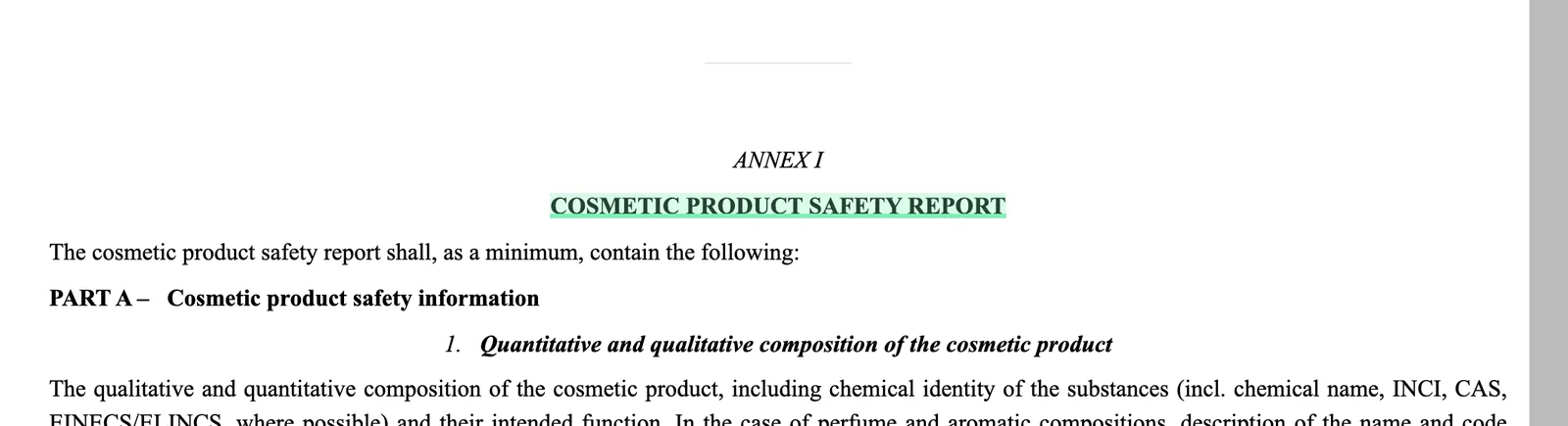
Before a cosmetic product can be placed on the EU or UK market, it must have a Cosmetic Product Safety Report. This is the formal safety assessment of the finished product, set out in Annex I of Regulation (EC) No 1223/2009 and its retained UK equivalent. The report must be completed and signed by a qualified safety assessor, a person who holds a university diploma in pharmacy, toxicology, medicine, or a similar discipline recognised by an EU Member State.
The CPSR sits inside the Product Information File and is one of the documents authorities can ask to see. Under Article 11 the PIF must hold the product description, the CPSR, the manufacturing method with a GMP statement referencing ISO 22716, proof of any claimed effect where that is justified, and data on any animal testing. The file is kept for 10 years after the last batch was placed on the market. A US safety report does not transfer to the EU or UK: the assessment has to be redone in the format the regulation requires, even where existing documentation exists.
What the report contains
Part A and Part B.
Annex I splits the CPSR into two parts. Part A gathers the safety information. Part B is the assessment and the signed conclusion.
Reviewed by Cassandra Maddocks, chemist & biochemist · last reviewed 26 July 2026
The Cosmetic Product Safety Report is the two-part safety assessment required under Article 10 and Annex I of Regulation 1223/2009, signed by a qualified assessor before any EU or UK sale. CIGREG produces and signs CPSRs for $450 to $600 per product once your data is complete.
Legal basis: EUR-Lex: Regulation (EC) 1223/2009, ISO 22716.
Part A: safety information
The data the assessment is built on:
Part B: safety assessment
The assessor's reasoning and decision:
Part B is the signed judgement. It is what makes the difference between a folder of test data and a legally valid safety report.
How CIGREG covers it
What is included.
A complete safety report compiled from your product data, with the safety conclusion signed by a named professional.
We compile the full Part A safety information from your formula and product data, covering composition, physico-chemical characteristics, stability, microbiological quality, impurities and traces, packaging, and use and exposure.
We build the toxicological profile ingredient by ingredient and calculate the Margin of Safety for the substances that need it.
A qualified safety assessor reviews and signs Part B. The safety conclusion is always made by a named professional holding a recognised pharmacy, toxicology, or medicine diploma, and the signed report carries that name, qualification, and date.
We set the label warnings and instructions that the assessment requires, so the report and the label agree.
We build it into your Product Information File so the dossier is complete under Article 11.
We keep it current if your formula, your packaging, or the rules change.
What we need from you
The inputs behind the report.
Most of what we ask for is documentation you already hold from your manufacturer or formulator. Where a piece is missing, we tell you what it is and why the regulation needs it, so you can request it from the right source. We do not ask for anything the assessment does not use.
Stability and challenge testing are the two inputs founders most often forget to budget for, and they are the two that most often set the real timeline. Stability testing can take from three to twelve months depending on the method, which is why a new formulation should start long before its planned launch date.
Timelines
How long it takes.
Once the inputs are in, the report itself is not the slow part. The lab work behind it usually is.
When your test data is complete and your formula is settled, we prepare and sign the CPSR without holding your launch back. Where testing is still outstanding, the timeline follows the lab, not the report. Stability testing runs from three to twelve months by method, and challenge and microbiological testing add their own lead times. A new formulation that has not yet been tested should allow several months end to end before it can be sold.
If you send us a product that already has current stability, challenge, and microbiological results, the assessment is a matter of compiling, calculating, and signing rather than waiting. Tell us your launch date when you ask for a quote and we will tell you plainly whether the testing behind the report can realistically be finished in time.
Edge cases
Products that need more.
Some products carry a wider scope. We flag these before they become a problem.
Nanomaterials
A product containing a nanomaterial needs a separate notification to the European Commission under Article 16 of Regulation 1223/2009, six months before it is placed on the market. This sits on top of the standard notification. The nanomaterial and its details must also be declared in the notification for the UK market.
Baby and child products
Products for babies and young children are assessed at a higher scope. Exposure, the toxicological margins, and the warnings are all examined more closely, so the assessment behind the report is more involved than for a standard adult product.
Higher-risk categories
Products such as hair dyes, oxidising and perming products, sunscreens making an SPF claim, and products for the eye area sit in higher-scope territory. Claims like SPF or water resistance also need their own substantiation testing before they can appear on the label.
Restricted and banned substances
Ingredients move between the annexes of Regulation 1223/2009 over time. An ingredient allowed today can be restricted or banned later, which can force a reformulation and a fresh assessment. We check your formula against the current annexes as part of the work.
Who it is for
Any product going on sale in the EU or UK.
Every cosmetic product placed on the EU or UK market needs a signed Cosmetic Product Safety Report before it can be sold. There is no small-business exemption and no turnover threshold: a maker selling a few bars of soap carries the same requirement as a large brand. This service suits brands that need that report prepared and signed, whether as a standalone deliverable or bundled with the Product Information File and notification in a launch pack.
A CPSR is prepared per product. A range of scents or shades built on the same base formula can often be assessed together as a framework, which keeps the cost down across a line. We tell you at quote stage which of your products can share an assessment and which need their own.
Pricing
Fixed, transparent pricing.
A signed safety report per product, or bundled with the Product Information File and notification in the launch pack.
Prices in USD, per product.
See full pricing →Where this service fits
The safety report in your compliance path.
FAQ
Common questions.
Related
Pairs well with.
Product Information File
The technical dossier the CPSR forms part of.
View service →EU Responsible Person
The mandate that holds your file and keeps the CPSR in place.
View service →UK Responsible Person
The same coverage for the British market.
View service →Sell in the EU
The full picture of what the EU market requires.
EU market →In practice
Compliance, in the real world.