Recurring mandate
Swiss responsible person and agent services.
A responsible person with a Swiss address for your cosmetics, as Swiss law requires, with your file retained for ten years.

What the law requires
A Swiss-address responsible person, separate from the EU.
Switzerland is not part of the EU and runs its own cosmetics regime. The rules sit under the Federal Act on Foodstuffs and Utility Articles (817.0), the Ordinance on Foodstuffs and Utility Articles, and the Ordinance on Cosmetic Products (817.023.331). Article 54 requires cosmetics to comply with the annexes of EU Reg. (EC) 1223/2009 for prohibited ingredients, colourants and preservatives, so the ingredient science is aligned with the EU. The obligations around who is accountable and how the market is policed are not.
To place cosmetics on the Swiss market, a brand needs a responsible person or agent with an address on Swiss territory. That role is the contact point for the authorities. It cannot be delegated to anyone located abroad, so an EU address printed on your packaging does not satisfy the Swiss requirement. The address may appear on the label, but the legal accountability has to sit on Swiss soil.
There is one detail brands often miss. In Switzerland the responsible person must be a physical person. If no one is designated, the role falls by default onto the company's CEO or equivalent legal representative, wherever they are based, which is rarely what a foreign brand intends. Appointing a Swiss agent removes that exposure and gives the authorities a named local contact.
A Product Information File must be held and kept available to the authorities for ten years from the date the last batch was first placed on the market. EU obligations do not carry over to Switzerland automatically. The Swiss requirement is separate and has to be met in its own right.
How the Swiss model differs
No portal, and post-market inspection instead.
The EU asks you to notify before launch. Switzerland asks you to be ready when an inspector calls.
Reviewed by Cassandra Maddocks, chemist & biochemist · last reviewed 26 July 2026
Swiss law requires a responsible person with an address on Swiss territory holding a complete self-monitoring dossier for ten years after the last batch. CIGREG provides that address, keeps the file current and inspection-ready for the cantonal laboratories, and checks that warnings appear in a Swiss official language.
Legal basis: Fedlex: Swiss Cosmetics Ordinance (VKos), ISO 22716.
Switzerland has no pre-market notification portal. There is no Swiss equivalent of CPNP or SCPN, and the Swiss authorities have no access to the EU CPNP database. Nothing is filed before your product goes on the shelf. Instead the market is controlled after the fact by cantonal laboratories across the 26 cantons, which run post-market inspections and can ask for your compliance data at any time.
That changes what "being compliant" means day to day. Rather than a one-off submission, you keep a self-monitoring dossier that stays current and can be handed over on request, sometimes with little notice. When an inspection comes, the responsible person is the party the canton contacts, and the Product Information File is what they expect to see.
Products lawfully marketed in the EU can generally enter Switzerland under the Cassis de Dijon principle without reformulation, provided they still meet the supplementary Swiss requirements and are not on the published negative list. That principle covers the product, not the paperwork. You still need the Swiss-address responsible person, the labelling in an official language, and the file held for ten years.
How CIGREG covers it
What is included.
A mandate that gives your products the Swiss address the law requires and keeps your file ready for inspection through the full retention period.
We act as your Swiss responsible person and agent, giving your products the Swiss address the law requires and a named contact point for the cantonal authorities.
We hold your Product Information File and retain it for the required ten years from the last batch, ready to hand to an inspecting canton on request.
We review your safety documentation against Swiss requirements. Where a safety assessment is needed, it is prepared and signed by a qualified assessor holding a recognised university diploma in pharmacy, toxicology, medicine, or a comparable discipline.
We check your labelling so warnings and instructions appear in at least one official Swiss language, German, French, or Italian.
We respond to the authorities during post-market inspections, as the party the canton contacts.
We keep your Swiss compliance current as your range grows and the annexes of Reg. 1223/2009 are updated.
Who performs and signs it
The safety assessment carries a real signature.
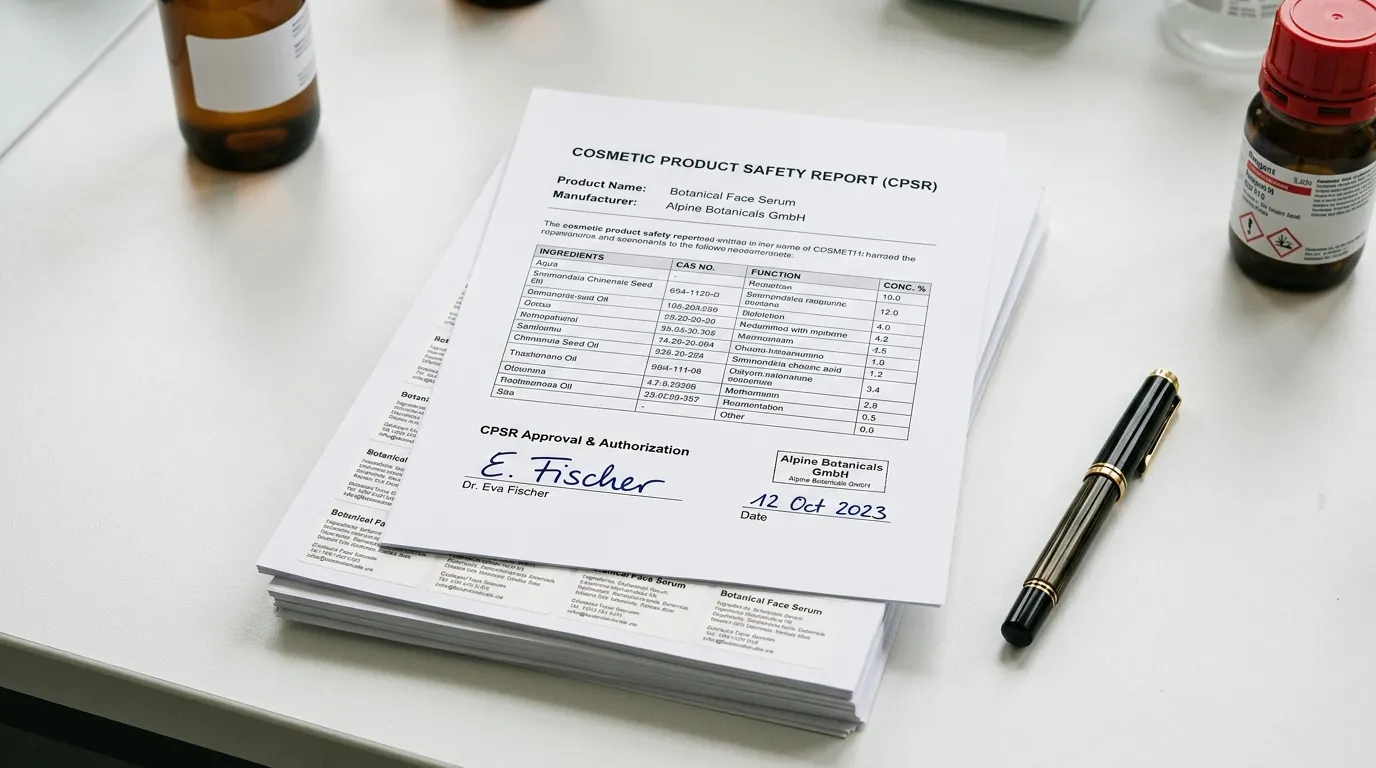
Switzerland relies on the same substance annexes as the EU, and the safety assessment behind your file has to be defensible on the same terms. Because Article 54 points to Reg. 1223/2009, the safety report is prepared to the CPSR standard set out in Annex I of that regulation. Part A gathers the safety information: composition, physico-chemical characteristics and stability, microbiological quality, impurities and packaging, use and exposure, and the toxicological profile. Part B is the assessment itself, with the conclusion, the warnings, the reasoning including the Margin of Safety, and the assessor's name, qualification, date and signature.
Part B is signed by a qualified safety assessor who holds a university diploma in pharmacy, toxicology, medicine, or a similar discipline recognised by an EU Member State. That is not a formality. A safety report is only worth what the person who signs it is qualified to stand behind, and it is what an inspector or a poison centre will read if there is ever a question about your product.
What we need from you
The inputs that let us start.
The quicker we have these, the sooner your Swiss coverage is in place. Most of it you already hold if you have prepared for the EU.
The full formula. Quantitative and qualitative composition with INCI names, and the raw-material and supplier documentation behind it.
Existing safety work. Any current CPSR or safety assessment, stability and challenge (preservation) test results, and microbiological data.
Your Product Information File, if you have one. A PIF compiled for the EU can satisfy Swiss requirements when it meets Swiss cosmetics and labelling rules. It may be written in an official Swiss language or in English.
Labels and packaging artwork, so we can check the warnings and instructions are in German, French, or Italian.
Manufacturing details, including the country of manufacture and a GMP statement to ISO 22716.
Anything special about the product, such as nanomaterials, or use on babies and children, which changes the scope of the work.
Who it is for
Brands placing cosmetics on the Swiss market.
If you sell, or plan to sell, cosmetics in Switzerland and you are not Swiss-based, you need a responsible person or agent with a Swiss address. This mandate suits brands already entering the EU who want Swiss coverage handled at the same time.
Timelines
How long it takes.
Appointing the agent is fast. The longest step is any laboratory testing your product still needs, which sits with the lab, not with us.
Because Switzerland has no notification portal, there is no submission to wait on and no queue at an authority. Once we hold your documents, the Swiss agent role can be in place quickly, and the address is then ready to appear on your packaging.
The realistic timeline depends on the state of your file. If your safety assessment and Product Information File are complete and already in an accepted language, the work is a review and the appointment, which is measured in a small number of days. If a safety assessment is still needed, add the time to prepare and sign it. If the underlying test data is missing, the schedule is set by the laboratory: stability testing alone commonly runs several months, so a product without any prior safety work should be planned around that, not around us.
The practical rule is the same one that applies for the EU. Start before you need the address on the shelf, and gather your formula, safety work and labels early, because that is what moves the date, not the appointment itself.
Edge cases and higher-scope products
Where the scope changes.
Most products are straightforward. A few categories need extra work, and it is better to know before you launch.
Nanomaterials
Products containing nanomaterials carry an extra layer under the EU annexes that Switzerland aligns to. In the EU these require a separate Article 16 notification on top of the standard route. Tell us at the start if any ingredient is present in nano form, because it changes both the documentation and the assessment.
Baby and child products
Products intended for babies and young children are treated as higher-scope. The exposure assumptions are stricter and the safety assessment is more demanding, which affects both the work involved and the price band for the assessment.
Specialist categories
Some categories, such as hair dyes and certain products with actives, sit at the more complex end of the safety assessment and are priced accordingly. Sun-exposure products face a Swiss-specific limit: furocoumarins are prohibited at 1 mg/kg or above.
Variants of one formula
Shades and scents built on the same base are not always separate assessments, but each finished product needs its own file entry and its own labelling check. We will tell you which variants can share safety work and which cannot when we see the range.
Swiss-specific taxes
Switzerland applies its own duties that have no EU equivalent, including a Swiss VAT rate and an incentive charge on certain volatile organic compounds. These are import and tax matters rather than part of the agent mandate, but they belong in your budgeting for the Swiss market.
Changing your agent
If you already sell in Switzerland through another provider, the role can be transferred. Your Product Information File moves with you and we take over as the contact point, so there is no gap in coverage while you switch.
How it fits with the other markets
One file, four regimes.
Most brands do not sell only in Switzerland. They reach Switzerland alongside the EU, the UK, and increasingly the United States, and each of those is a separate legal regime with its own rules on who is accountable and how notification works.
The EU needs an EU-established Responsible Person, a Product Information File, a signed CPSR, and a CPNP notification under Reg. 1223/2009. Great Britain needs a UK-established Responsible Person and an SCPN notification through OPSS, and CPNP and SCPN are separate systems that do not talk to each other. The United States, under MoCRA, needs facility registration, annual product listing, and a US Agent for foreign facilities. Switzerland sits alongside all three with its Swiss-address agent and its ten-year file.
The efficiency is in the shared foundation. The formula, the stability and challenge testing, and the toxicological reasoning are largely the same underneath, so the safety work done once feeds the CPSR for the EU, the file for the UK, and the assessment behind your Swiss coverage. What differs is who signs, who is on the label, and where the notification goes. Holding all four with one partner keeps that foundation in one place instead of rebuilt four times.
Pricing
Fixed, transparent pricing.
Swiss agent coverage is quoted per product and per portfolio. Supporting deliverables follow our published rates, and ongoing Swiss coverage can be combined into Compliance Care.
Prices in USD, per product unless noted.
See full pricing →Where this service fits
The Swiss agent in your compliance path.
FAQ
Common questions.
Related
Pairs well with.
Sell in Switzerland
The full market overview of what Switzerland requires and how CIGREG covers it.
Swiss market →Product Information File
The technical dossier retained for ten years in Switzerland.
View service →EU Responsible Person
Cover the European Union alongside Switzerland.
View service →Compliance Care
Keep your Swiss coverage current with ongoing monitoring.
View service →In practice
Compliance, in the real world.