What the law requires
What the UK market requires.
Since leaving the EU, Great Britain runs its own cosmetics regime, and an EU Responsible Person does not satisfy it. To sell a cosmetic in Great Britain, your brand must meet its own set of obligations.
Reviewed by Cassandra Maddocks, chemist & biochemist · last reviewed 26 July 2026
Great Britain requires a UK-established Responsible Person, an SCPN notification before sale, and GB labels naming the UK RP. The rules mirror the EU's retained regulation, but nothing filed in the EU counts. CIGREG holds the role, files the SCPN and reviews your GB labels at fixed prices.
Legal basis: legislation.gov.uk: Cosmetic Products Enforcement Regulations 2013, SCPN portal (GOV.UK), GOV.UK guidance.
Brands already selling in the EU often assume their EU compliance carries over. It does not. Great Britain is a separate market with its own Responsible Person requirement, its own notification portal, and its own enforcement.
The UK Cosmetics Regulation
On 1 January 2021 the UK left the EU cosmetics system and kept a retained version of Regulation (EC) No 1223/2009, now called the UK Cosmetics Regulation. It is enforced through the Cosmetic Products Enforcement Regulations 2013. The technical rules are close to the EU version, so the ingredient annexes and the shape of the safety file feel familiar, but the legal duties sit with a separate UK regime. Northern Ireland is treated differently: under the Windsor Framework the NI market continues to follow EU Reg. 1223/2009, which means NI-facing products use the EU Responsible Person and CPNP route rather than the Great Britain route described here.
The Responsible Person, and who can hold it
Any cosmetic made available in Great Britain must have a Responsible Person established in the UK. Before Brexit an EU-based Responsible Person was accepted for the UK market. That is no longer the case: the Responsible Person must now have a genuine UK-established address. PO boxes and mail-forwarding addresses do not qualify. The role can be held by the manufacturer, the importer, a distributor, or a third-party service provider based in the UK. A brand with no UK entity of its own appoints a UK-based provider to hold the role. The Responsible Person keeps the Product Information File, notifies OPSS before a product is made available, reviews labelling and claims, and reports serious undesirable effects. That responsibility is continuous for as long as the product stays on the market, not a one-off filing at launch.
Notification through SCPN and OPSS
Notification for the Great Britain market goes through SCPN, the Submit Cosmetic Product Notification portal operated by the Office for Product Safety and Standards (OPSS). SCPN replaced the EU CPNP for Great Britain. The two portals run independently and do not talk to each other, so an EU CPNP notification does nothing for Great Britain, and a UK SCPN notification does nothing for the EU. Each product is notified before it is made available. An SCPN notification includes the product category and name, the Responsible Person details, the location of the Product Information File, an emergency contact, nanomaterial and CMR-substance details, the framework or ingredient formulation, and images of the label and packaging.
The Product Information File
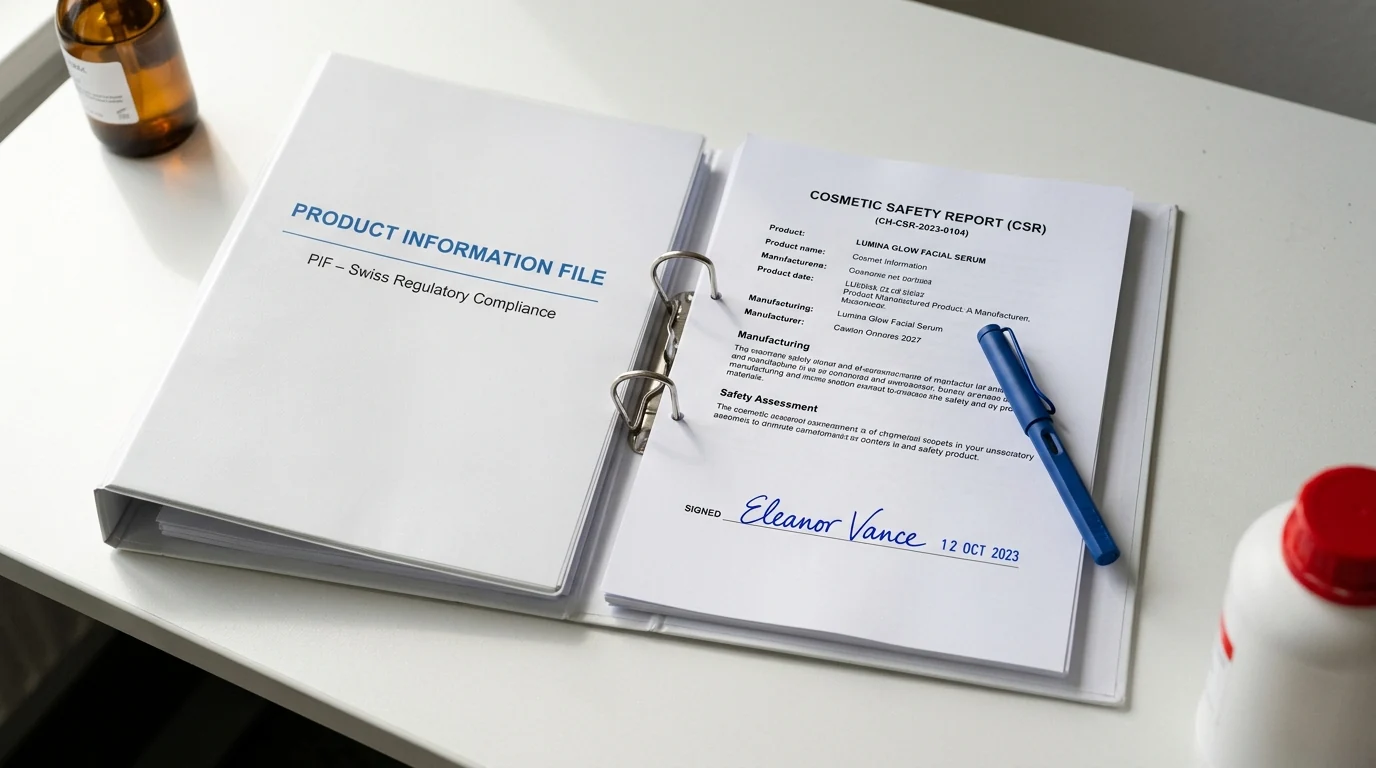
The Responsible Person holds a Product Information File for each product and keeps it for 10 years after the last batch was placed on the market. The file follows the same structure as the EU version. It contains a description of the product, the safety report, the manufacturing method with a statement of good manufacturing practice (ISO 22716), proof of any claimed effect where a claim needs it, and data on any animal testing. Inside the file, the safety report has two parts. Part A gathers the safety information: composition, physico-chemical characteristics and stability, microbiological quality including challenge testing, impurities and packaging, use and exposure, and the toxicological profile. Part B is the safety assessment itself: the conclusion, warnings, the reasoning including the Margin of Safety, and the assessor’s name, qualification, date and signature. The Part B assessment must be signed by a qualified assessor holding a university diploma in pharmacy, toxicology, medicine, or a comparable recognised discipline. A US safety report does not transfer into this format, so an existing non-UK assessment usually has to be redone as a UK-format report.
Label requirements
The Responsible Person’s name and address must appear on the product label. A product sold in both Great Britain and the EU carries both addresses: the UK Responsible Person address on GB labels and the EU Responsible Person address on EU labels. The label also carries the usual cosmetic details, including the ingredient list in INCI names, the batch number, and warnings. Missing batch numbers, missing INCI, and untranslated or absent warnings are among the labelling errors that force relabelling or withdrawal.
Penalties and enforcement
Failing to notify OPSS is an offence. It can carry a fine and up to 3 months’ imprisonment. Fines are unlimited in England and Wales, and up to £5,000 in Scotland and Northern Ireland. OPSS and Trading Standards can prohibit sales until the product is compliant. Enforcement in Great Britain works by market surveillance and inspection rather than pre-market approval, so a product can sell for a while before a request for documentation arrives, and the liability sits with the Responsible Person the whole time.
How it works, step by step
From your formula to a live UK listing.
The path to a compliant UK launch is a known sequence. Most of the elapsed time is document preparation, not the notification itself. When the file is ready, the SCPN notification is quick. When it is not, a first-time attempt can stall for weeks on missing test data or an unsigned safety report.
Send us your products
You share the full formula with percentages, the INCI list, the manufacturing details, label artwork, and any testing you already hold. This is the point where a US or non-UK safety report is reviewed to see how much can be reused.
Fixed quote before any work
We quote your UK coverage at a fixed price against the productised prices below, so the cost is known before work begins. Nothing is filed and no fee runs on until you accept.
Safety report signed by a qualified assessor
A qualified safety assessor reviews the formulation and signs the Part B safety assessment. Where a claim needs support, the claim is checked against the evidence. If test data is missing, the timeline here depends on getting it, since stability and challenge testing run on their own schedule.
Product Information File assembled
We build the UK Product Information File around the signed report and hold it for the 10-year retention period, ready for OPSS or Trading Standards on request.
SCPN notification to OPSS
We notify each product through SCPN, only after you confirm. When the documents are ready, an SCPN notification typically clears in about 2 to 5 business days. A first-time do-it-yourself attempt often stretches to several weeks because the file is not yet complete, so plan to start roughly 6 to 8 weeks before your intended launch.
We stay your Responsible Person
We remain your UK Responsible Person for as long as the product is on the market, handle authority correspondence, and keep notifications current when a formula or label changes.
Why products get pulled here
What trips up first-time UK sellers.
Most UK problems are not exotic. They come from the same handful of gaps that surface at inspection, at a marketplace listing check, or at the border. Knowing them in advance is the difference between a clean launch and a suppressed listing.
No UK Responsible Person
Relying on an EU Responsible Person for Great Britain, or on no Responsible Person at all. Without a valid UK one, marketplaces suppress or remove the listing and OPSS can prohibit sales.
Assuming one portal covers both
Notifying the EU CPNP and assuming Great Britain is covered. CPNP and SCPN are separate systems, so a GB product with only an EU notification is unnotified in Great Britain.
An incomplete or missing PIF
A file with gaps, or no file at all. When OPSS or Trading Standards ask, the Responsible Person has to produce a complete Product Information File, including the signed safety report.
Labelling errors
Missing batch numbers, missing or wrong INCI, absent warnings, or no Responsible Person address on the label. Any of these can force relabelling or withdrawal.
A restricted or banned ingredient
An ingredient that fails the UK annexes. The safety report is where this is caught before the product ships, not after.
A PO box address
A UK Responsible Person address that is a PO box or mail-forwarding service. It does not qualify, and a notification resting on one is not valid.
How CIGREG covers it
Your full UK compliance, in one relationship.
CIGREG acts as your UK Responsible Person, holds and maintains your UK Product Information File, and files your SCPN notification through OPSS after your confirmation. A qualified safety assessor signs your safety report. We handle UK authority correspondence and keep your notifications current.
Why CIGREG
Why brands choose CIGREG for the UK.
No UK entity required
A UK Responsible Person without a UK entity of your own.
Fixed, published pricing
Productised prices, with a fixed quote before any work begins.
Signed and insured
Qualified assessor sign-off on every safety report and an insured Responsible Person role.
Four markets, one partner
The UK covered alongside the EU, Switzerland and the US, from a single relationship.
What it costs
Fixed prices for UK coverage.
Prices are productised and quoted per product before any work starts. The launch pack covers the EU and the UK together, so a brand selling in both markets pays once for the safety work and gets both notifications. UK-only components can be bought on their own.
What you need in this market
The UK requirements, each handled by a CIGREG service.
UK questions, answered
Frequently asked questions.
In practice
Compliance, in the real world.