What the law requires
What the Swiss market requires.
Switzerland sits outside the EU and runs its own cosmetics rules. EU compliance does not carry across the Swiss border on its own. To sell a cosmetic in Switzerland, your brand must meet Swiss requirements directly.
Reviewed by Cassandra Maddocks, chemist & biochemist · last reviewed 26 July 2026
Switzerland requires a responsible person with a Swiss-territory address and a self-monitoring dossier kept ten years for cantonal inspection; there is no notification portal. Warnings must appear in at least one of German, French or Italian. CIGREG provides the Swiss address, holds the file and checks the labels.
Legal basis: Fedlex: Swiss Cosmetics Ordinance (VKos), EUR-Lex: Regulation (EC) 1223/2009.
The Swiss requirement is separate from the EU one, so a brand selling in both markets needs cover in each. They fit together in one relationship, but they are two obligations.
The Swiss regime, in plain terms
Swiss cosmetics rules sit under the Federal Act on Foodstuffs and Utility Articles (817.0) and the Ordinance on Foodstuffs and Utility Articles. The instrument that governs cosmetics directly is Ordinance 817.023.331, the Ordinance on Cosmetic Products. Article 54 of the wider framework requires cosmetics to comply with the annexes of EU Regulation 1223/2009, so the prohibited-ingredient, colourant and preservative lists that apply in the EU also apply in Switzerland. The formulation rules line up closely with the EU. The compliance structure around them does not.
A Swiss-address responsible person, held on Swiss territory
The responsible person for the Swiss market can be the manufacturer, the importer, or an appointed agent, but that person or entity must have an address on Swiss territory. An importer or distributor may appoint an authorised representative in writing, provided that representative holds a Swiss address. The Swiss meaning of the role differs from the EU one. In Switzerland the responsible person is the contact point for the surveillance authorities and must be a physical person. If a brand does not designate anyone, the role does not simply lapse: the company’s CEO or equivalent legal representative assumes it by default, wherever they are based. For a foreign brand, that is usually unintended personal exposure rather than a deliberate choice.
An EU Responsible Person does not satisfy this requirement. An EU address may be printed on the packaging, but the legal obligation cannot be delegated to it or to anyone located abroad. Swiss authorities have no access to the EU CPNP database and cannot read your EU notification. The obligation has to sit inside Switzerland.
No pre-market notification: control is by cantonal inspection
Switzerland has no notification portal and no pre-market registration step. There is no Swiss equivalent of CPNP or SCPN, and nothing to submit before a product goes on sale. Instead, control happens after the product is on the market. Cantonal enforcement laboratories, working across the 26 cantons, carry out post-market inspections and can request your compliance data at any time. Because inspections are unannounced, the practical obligation is to hold a complete, current self-monitoring dossier ready to hand over on request, rather than to file anything up front.
The Product Information File and its ten-year clock
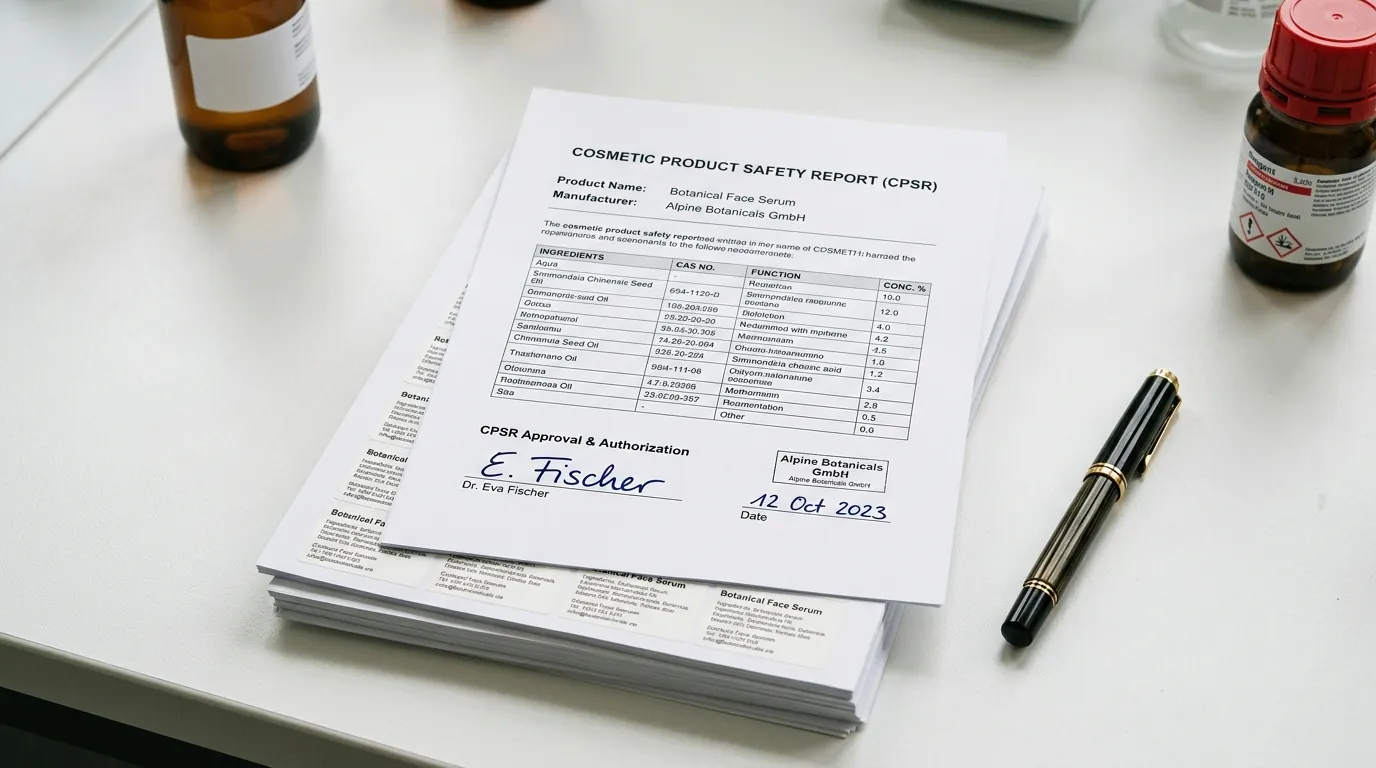
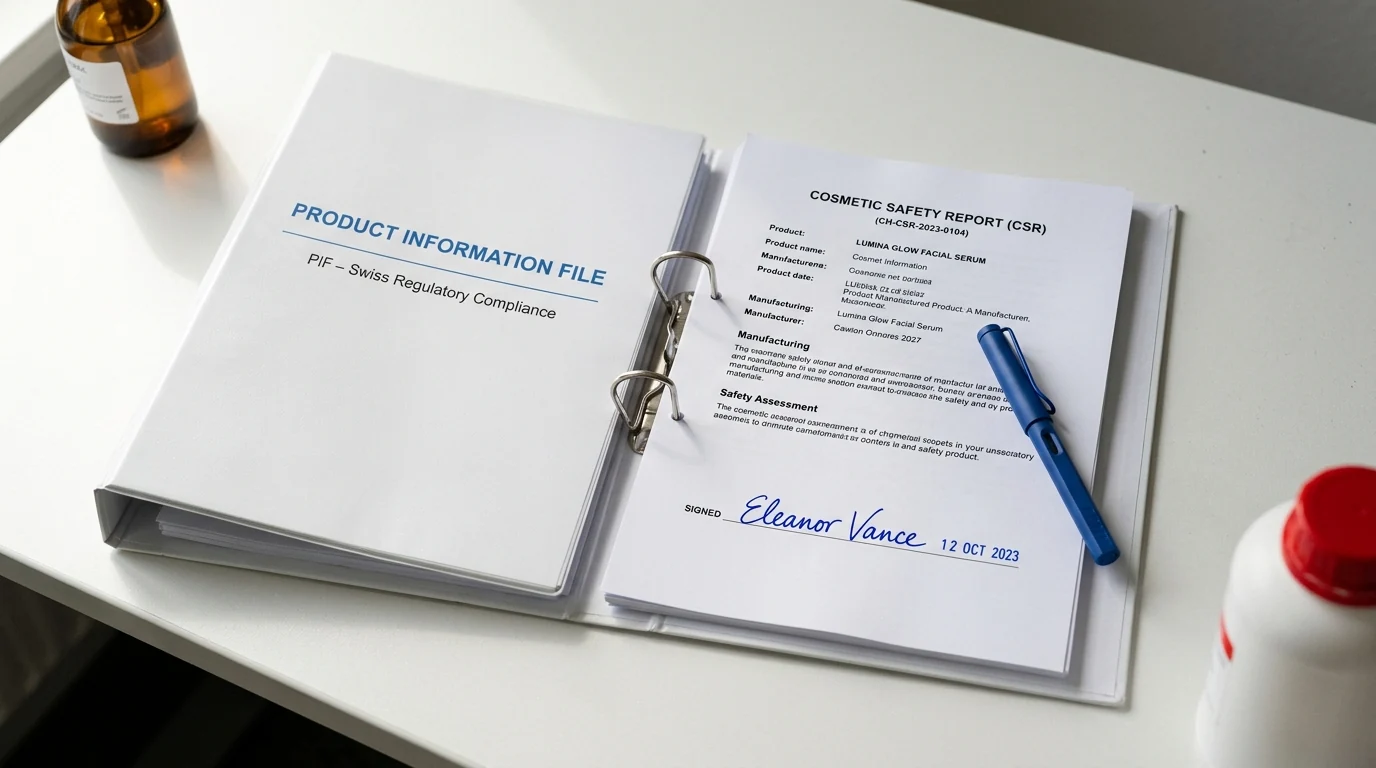
Each product needs a Product Information File that an inspector can be given on request. The file must be kept for ten years from the date the last batch was first placed on the market, and it has to stay available to the authorities for that whole period. A Product Information File already compiled abroad, for example an EU file, can satisfy the Swiss requirement if it meets Swiss cosmetics and labelling rules. It may be written in an official Swiss language or in English. The underlying safety work still has to be there: a safety assessment signed by a qualified assessor, a manufacturing method with a GMP statement to ISO 22716, stability and microbiological data, and support for any claim the label makes.
Labelling and Swiss language rules
Warnings and instructions for use must appear in at least one official Swiss language, meaning German, French, or Italian. EU or UK claim approvals do not carry across automatically, so packaging that is compliant for an EU shelf is not automatically compliant for a Swiss one. Switzerland also diverges from the EU on some technical points. It regulates chemicals under its own Chemical Risk Reduction Ordinance (ORRChem) rather than REACH, and it prohibits furocoumarins at or above 1 mg/kg in products intended for sun exposure. Products lawfully marketed in the EU can enter Switzerland under the Cassis de Dijon principle without reformulation, provided they still meet the supplementary Swiss requirements and are not on the published negative list.
Enforcement and who carries the risk
Enforcement is the job of the cantonal laboratories, exercised through post-market inspection rather than an approval gate. In practice the liability tends to land on the Swiss importer, who by default holds the Product Information File. A foreign brand without its own Swiss entity depends on that importer or on a paid agent, which complicates control of the dossier if the importer relationship changes. Appointing your own Swiss agent keeps the file and the named contact under your control rather than tied to a single distributor.
How CIGREG covers it
Your Swiss compliance, handled for you.
CIGREG acts as your Swiss responsible person and agent. We give your products the required Swiss address, hold your Product Information File for the full ten years, and handle contact with Swiss authorities on your behalf. As your range grows and the rules change, we keep your Swiss compliance current.
How it works, step by step
From first email to a Swiss shelf.
Because Switzerland has no notification portal, the work is about building a complete file and putting a named Swiss contact behind it, then keeping both ready for inspection. Here is the order it runs in.
Submit your products
Send us your product list, formulas with full INCI, existing safety reports, current labels, and where the products are made. We tell you which of these already meet Swiss rules and what is still missing.
Receive a fixed quote
You get a fixed price and a timeline for Swiss coverage before any work starts. If you also need the EU, UK, or US, the quote covers those markets in the same document.
We build or check the file
We assemble the Product Information File to Swiss requirements or check an existing EU file against them. Where a signed safety report is needed, a qualified assessor prepares and signs it.
We fix the label
We review your label and claims for Swiss rules, including warnings in an official Swiss language, and tell you exactly what to change before the product ships.
We become your Swiss contact
We take on the responsible person and agent role with a Swiss address, and we hold your file for the full ten-year retention period.
Ready for inspection
Your dossier stays current and available to the cantonal laboratories. If an inspector asks for it, the complete file is already in place, and we handle the exchange.
Realistic timelines
How long this takes depends almost entirely on the state of your paperwork, not on any filing queue, because there is nothing to file. When your safety reports, formulas, and labels are already in order and only need checking against Swiss rules, appointing the Swiss agent and confirming the file is a matter of a short onboarding window. When a product still needs a signed safety assessment, or the underlying stability and microbiological testing has not been done, that testing sets the pace. Stability testing in particular can run for months, and no responsible person can compress it. The honest planning rule is to start Swiss coverage well before your intended launch, and to treat any missing lab work as the long pole in the schedule rather than the compliance paperwork itself.
Why products get pulled here
What goes wrong for first-timers.
Swiss control happens after a product is already on sale, so problems surface during an inspection rather than at a submission screen. These are the recurring reasons a foreign brand gets caught out.
Why CIGREG
Why brands choose CIGREG for Switzerland.
Swiss agent of record
Your responsible person sits in Switzerland, with a real Swiss address behind the role.
Fits with EU access
We cover Switzerland alongside the EU for brands selling in both markets.
Fixed, transparent pricing
Published prices, with a fixed quote before any work begins.
Four markets, one partner
Switzerland covered alongside the EU, UK and US, from a single relationship.
What you need in this market
The Swiss requirements, each handled by a CIGREG service.
FAQ
Common questions about selling in Switzerland.
In practice
Compliance, in the real world.