UK regulatory guide
How to sell cosmetics in the UK.
A practical guide to the UK Cosmetics Regulation: the UK Responsible Person, the Product Information File and SCPN notification through OPSS.

Reviewed by Cassandra Maddocks, chemist & biochemist · last reviewed 5 July 2026
When the UK left the European Union, it carried the substance of the EU cosmetics regime into domestic law as the UK Cosmetics Regulation, but ran it separately. The consequence for brands is often misunderstood: compliance in the EU does not give you compliance in Great Britain. The UK is its own market with its own requirements, and a product must satisfy them separately. This guide sets out what that takes, from who counts as your Responsible Person to how a notification reaches the Office for Product Safety and Standards.
- A UK-established Responsible Person for every product.
- A UK Product Information File, kept current.
- A safety report signed by a qualified assessor.
- An SCPN notification through OPSS before market entry.
- Labelling and claims that meet UK requirements.
The regime, and how it split from the EU
Great Britain has run its own cosmetics regime since 1 January 2021. The rulebook is the UK Cosmetics Regulation, the retained version of EC Regulation 1223/2009, enforced through the Cosmetic Products Enforcement Regulations 2013. The chemistry, the documents and the vocabulary carried over from the EU regime almost unchanged, which is why brands assume the two markets are interchangeable. They are not. The systems are separate, the portals are separate, and the two rulebooks now evolve independently, so a divergence that exists today can widen over time. A product already legal in the EU still needs its own UK Responsible Person, its own file and its own notification before it can be made available in Great Britain.
Who needs this, and who counts as the seller
The UK regime has no small-business exemption and no turnover threshold. A person selling a few bars of handmade soap from home faces the same core duties as a large manufacturer: a UK Responsible Person, a Product Information File, a signed safety report and an SCPN notification for each product. The fixed cost falls hardest on the smallest sellers, but the rules apply the same way. It also does not matter where you sell. Selling through your own Shopify site, through Amazon, or through Etsy makes no difference to what the law requires, even where a marketplace does not check your paperwork at the point of listing.
The UK Responsible Person
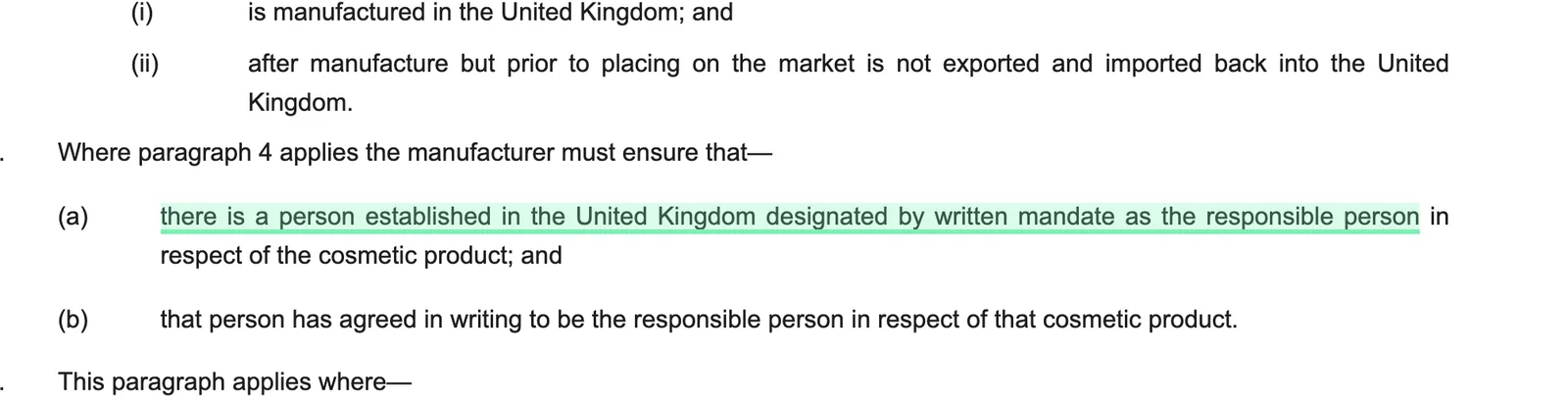
Every cosmetic product made available in Great Britain must have a Responsible Person established in the UK. The role mirrors the EU one: the UK RP is legally accountable for the product's compliance, holds its documentation, notifies OPSS before the product is available, and reports serious undesirable effects. An EU-based RP does not meet this requirement. Before Brexit an EU-based RP was acceptable for the UK market; it no longer is, and the RP must now be established in the UK. The address has to be a genuine UK-established address. PO boxes and mail-forwarding addresses do not qualify. The RP's name and address must appear on the product label, so a product sold in both markets carries the UK RP address on GB labels and the EU RP address on EU labels. A brand selling into both the EU and the UK therefore needs an RP in each, because one Responsible Person cannot cover both markets. CIGREG can act as your UK Responsible Person.
The Product Information File
The UK RP must hold a Product Information File for each product and keep it for ten years after the last batch was placed on the market. Its contents are closely aligned with the EU PIF: a description of the product, the safety report, the manufacturing method with a statement of good manufacturing practice (ISO 22716), evidence for any claimed effect where justified, and data on any animal testing. It must be kept current for the life of the product and made available to the authorities on request. See our Product Information File service.
The safety report
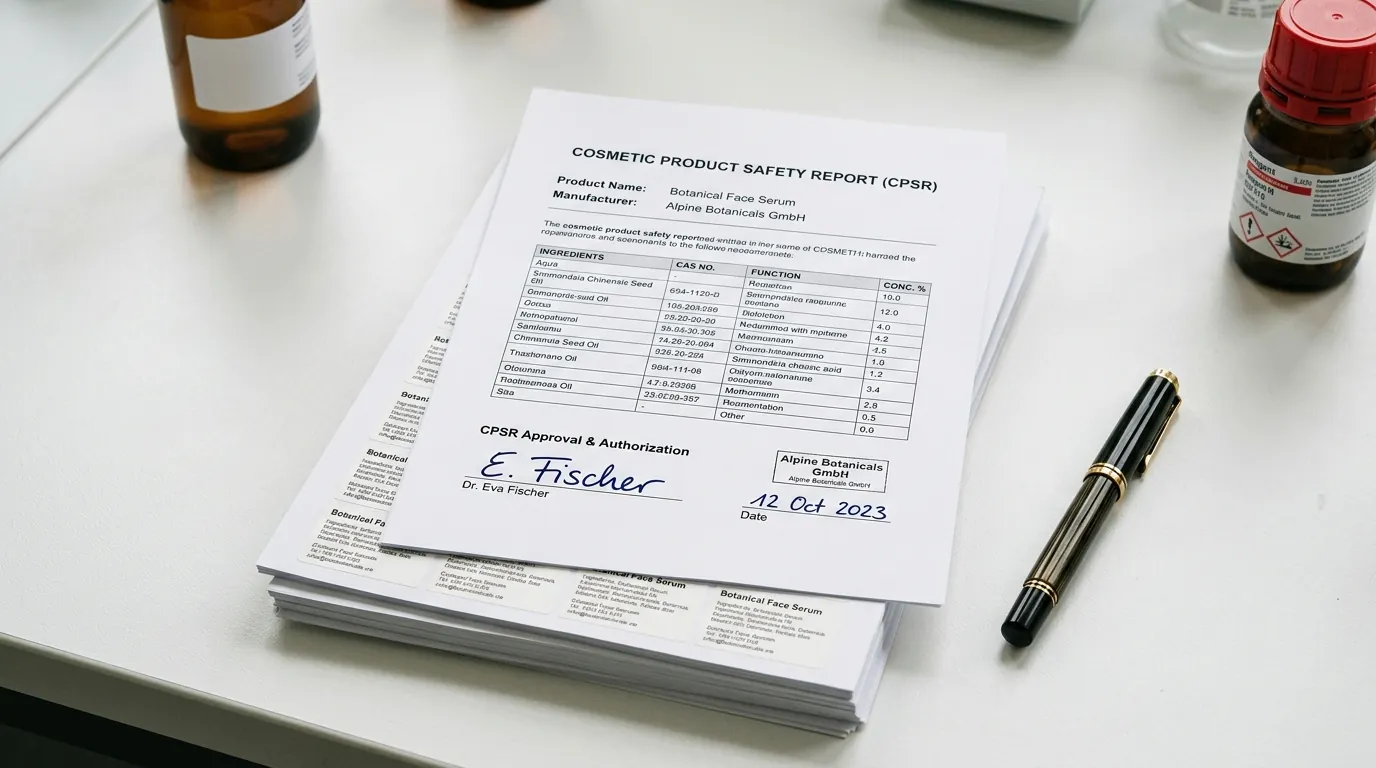
A cosmetic on the UK market must have a safety assessment equivalent to the EU CPSR, completed and signed by a qualified safety assessor. The report is in two parts. Part A is the safety information: the composition, physico-chemical characteristics and stability, microbiological quality including challenge testing, impurities and packaging, use and exposure, the toxicological profile and any undesirable effects. Part B is the assessment itself, the assessor's reasoned conclusion, warnings and margin-of-safety reasoning, signed and dated by a person holding a suitable university qualification in pharmacy, toxicology, medicine or a similar discipline. The scientific standard matches the EU, and the underlying assessment for a product can often be aligned across the EU and UK. Each market still needs its own valid report on file. Our safety assessment (CPSR) service covers both.
PIF, safety report and safety assessment: how they fit together
Brands often conflate these three terms, so it helps to see how they nest. The safety assessment is Part B of the safety report, the assessor's signed conclusion for one product. The safety report is Part A and Part B together, the full record of the product's safety. The Product Information File is the wider dossier that holds the safety report plus the product description, the manufacturing method and GMP statement, the claim substantiation and the animal-testing data. You need all three, per product, and the RP holds them.
SCPN notification through OPSS
UK notifications do not go through the EU's CPNP. Products must be notified through the Submit Cosmetic Product Notification service, the SCPN: covered in depth in our SCPN notification guide. The service is operated by the Office for Product Safety and Standards, the OPSS. CPNP and SCPN are entirely separate systems that do not talk to each other, so an EU notification does nothing for the UK. Each SCPN notification includes the product category and name, the RP's details, the location of the PIF, an emergency contact, nanomaterial and CMR-substance details, the framework or ingredient formulation, and images of the label and packaging. As in the EU, a product must be notified before it is made available on the market. We file these through our notifications service.
Labelling and claims
UK labelling requirements broadly track the EU's: an INCI ingredient list, the mandatory information, and claims that are truthful and supportable. The two regimes now diverge in places, and those divergences can grow over time as each rulebook is amended independently, so labels intended for both markets should be checked against each set of rules rather than assumed to be interchangeable. A label and claims review catches the divergences early, before artwork goes to print.
Northern Ireland is a separate case
"The UK" is not a single market for these purposes. Under the Windsor Framework, the Northern Ireland market continues to follow EU Regulation 1223/2009, which means products made available in Northern Ireland align with the EU route: an EU-recognised Responsible Person and CPNP notification, not the GB UK-RP and SCPN route. A brand selling across Great Britain and Northern Ireland is therefore working with the GB regime for one and the EU regime for the other. This is easy to miss, and it is one of the reasons an EU RP alone can still leave gaps in UK coverage.
Step by step: launching a product in the UK
- 1Appoint a UK-established Responsible Person and give them the genuine UK address that will appear on your GB label.
- 2Gather the technical inputs: the full INCI formulation with percentages, manufacturing details and a GMP statement, stability and challenge-test data, packaging information, artwork and the claims you intend to make.
- 3Have a qualified safety assessor prepare and sign the safety report (Part A information and Part B assessment).
- 4Assemble the Product Information File around the safety report so it holds everything the regulation requires.
- 5Check the label and claims against UK requirements, including the RP address and INCI list, and correct anything before printing.
- 6Submit the SCPN notification through OPSS before the product is made available on the GB market.
- 7If you also sell in Northern Ireland or the EU, run the parallel EU route (EU RP and CPNP) for those markets.
- 8Keep the PIF current for the life of the product and for ten years after the last batch.
Realistic timelines
The honest answer to "how long does this take" is months, not weeks, and the long pole is usually testing rather than paperwork. Stability testing in particular can run for several months, and for a brand-new formulation the full path from a standing start to a notified product commonly takes a few months once testing is factored in. Where a formula is already made, tested and stable, the compliance work moves faster: the assessor prepares the safety report, the PIF is assembled and the SCPN notification follows once the file is ready. Brands run into trouble when they treat compliance as a final formality and start it a fortnight before a planned launch. The fix is to appoint the RP and begin the dossier early, in parallel with production, so the notification is the last quick step rather than the bottleneck.
The mistakes that cause recalls and takedowns
Most first-time failures come from a short list of avoidable problems. Assuming an EU notification also covers Great Britain is the most common and most costly, because CPNP and SCPN are separate and neither reads across to the other. Appointing only one Responsible Person, or leaving an EU RP in place for GB sales, leaves the product without a valid UK RP. An incomplete or out-of-date PIF is a frequent finding. Labelling errors are common: a missing or wrong RP address, missing batch numbers, untranslated warnings, or an ingredient list that is not in proper INCI form. Using an ingredient that is prohibited or restricted under the regulation, or making an unsubstantiated claim, can force relabelling. Failing to notify OPSS, or failing to appoint a UK RP at all, leaves the product unlawfully on the market from day one. Any of these can lead to relabelling, withdrawal or a recall.
Penalties for not notifying
The consequences of skipping notification are set out in law. Failing to notify OPSS can carry a fine and up to three months' imprisonment. Fines are unlimited in England and Wales, and up to £5,000 in Scotland and Northern Ireland. OPSS and Trading Standards can prohibit sales until compliance is achieved. These are the reasons notification is a legal gate before a product reaches the shelf, not a formality to complete afterwards.
Marketplaces: the RP as a commercial gate
A marketplace not checking your paperwork at the point of listing does not mean you are exempt. The seller remains fully liable and can be asked for documentation at any time. Amazon, Etsy and Notino now require proof of Responsible Person appointment before listing cosmetics, which makes the RP a commercial gatekeeper as well as a legal one. Without a valid UK RP, Amazon can suppress a listing so shoppers cannot see it, suspend the account, and lock FBA inventory held in-country, and non-compliant goods can be seized and destroyed at customs. Sellers also hit a frustrating loop where they submit RP and manufacturer information, see a green "Approved" status, and still face a warning demanding the same details. The underlying fix is the same in every case: a valid UK RP, a complete dossier and a correct notification on file.
Switching your Responsible Person
Brands are often anxious about being locked in to an RP provider. A change of Responsible Person is a normal, supported process. A new RP can take over the existing SCPN notifications and manage future updates, so switching does not mean re-registering every product from scratch. The aim of any handover is that there is no gap in coverage while the product stays on the market. If you are already selling and want to move your UK RP to CIGREG, that transfer is part of what we do.
What this means in practice
To sell a product in Great Britain a brand needs a UK Responsible Person with a genuine UK address, a UK Product Information File, a safety report signed by a qualified assessor, an SCPN notification through OPSS and compliant labelling. The most frequent and most costly mistake is assuming EU compliance is enough. It is not, and Northern Ireland adds a further wrinkle by following the EU route. Brands expanding from the EU into the UK, or launching in both at once, usually appoint a partner that can act as RP in each market and keep the two sets of files aligned. That is the role CIGREG plays. Our EU and UK launch pack covers the safety report, PIF and notification for one product at a fixed $1,500, and Compliance Care keeps the RP role and dossiers current after launch. For a market-level overview, see selling in the UK.
Primary sources cited in this guide. Regulatory status last verified 5 July 2026.
Put this into practice
From reading to selling in the UK.
UK questions, answered
Frequently asked questions.
In practice
Compliance, in the real world.