EU regulatory guide

The CPNP notification, explained.

Every cosmetic product needs a notification on the Cosmetic Products Notification Portal before it is sold in the EU. This guide answers the questions brands actually ask about it: who files, what goes in, what it costs, and what it does not do.
A cosmetic product notification being prepared for the EU market

Reviewed by Cassandra Maddocks, chemist & biochemist · last reviewed 26 July 2026

What is the CPNP?

The CPNP is the European Commission's free, EU-wide notification portal for cosmetic products, required by Article 13 of Regulation (EC) No 1223/2009. One notification covers every EU member state: no further national filing is needed.

The portal is operated by the European Commission, and its official information page is published by DG Internal Market. Notification is a record, not an approval: the Commission does not review or clear the product. Compliance remains the responsibility of the product's EU Responsible Person at all times.
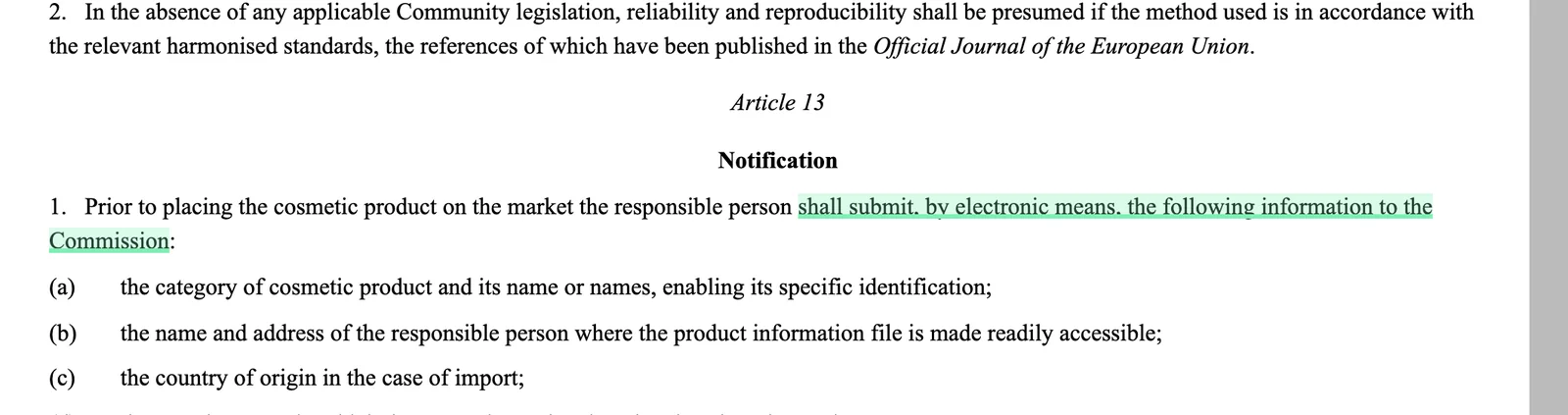
Article 13 of Regulation 1223/2009 on EUR-Lex with the electronic notification requirement highlighted
Article 13(1) of Regulation (EC) No 1223/2009, the notification requirement, as published on EUR-Lex, consolidation of 1 May 2026 (02009R1223, EN, 040.001). Captured 26 July 2026. View the official text.

Who files the CPNP notification?

Only the product's EU-established Responsible Person can submit the Article 13 notification. A brand outside the EU cannot file for itself without an EU establishment, and a distributor cannot substitute for the Responsible Person. Distributors have their own, narrower notification duties.

Under Article 13(3), a distributor who translates a label or otherwise makes a product available in a member state under its own initiative also notifies certain details, but this never replaces the Responsible Person's product notification. For the full picture of the EU regime around the notification, see selling in the EU and the complete EU guide.

What information does a CPNP notification contain?

The Article 13 notification covers the product's category and name, the Responsible Person's details, the country of origin for imports, the member state of first placing on the market, a contact person, the presence of nanomaterials and certain CMR substances, the frame formulation, and the original label with a photograph of the packaging.

In practice, the notification is only as ready as the dossier behind it. The formulation details come from the same work that produces the Cosmetic Product Safety Report, and the label you upload should already have passed a label and claims review. A notification that contradicts the label invites market-surveillance questions later.

When must the notification be filed?

Before the product is placed on the EU market: selling first and notifying later is not permitted. There is no waiting period or approval step: once the Responsible Person submits the notification, the product may go on sale.

The filing itself takes minutes when the documentation is ready. The realistic timeline is set by everything upstream: appointing the Responsible Person, completing the safety assessment and assembling the Product Information File. Plan those weeks before your launch date, not the notification.

Do nanomaterials need a separate notification?

Yes. Under Article 16 of Regulation 1223/2009, a product containing nanomaterials must be notified to the Commission six months before being placed on the market, through a dedicated CPNP module, in addition to the standard Article 13 notification.

The six-month lead time is the detail that catches brands out: a formulation containing an in-scope nanomaterial effectively adds half a year to the launch runway unless the material is already listed in the regulation's annexes.

Who can see my formula on CPNP?

Access is restricted. CPNP data is available to competent authorities, for market surveillance and enforcement, and to poison centres for medical treatment. Your formulation is not visible to the public or to competitors.

This is the most common confidentiality worry we hear, and the answer is consistent across the EU: the portal exists so that authorities and poison centres can act, not as a public register of formulas.

Does a CPNP notification cover the UK?

No. Since Brexit, Great Britain runs its own notification through the Submit Cosmetic Product Notification service, filed by a UK-established Responsible Person. Northern Ireland stays with the EU regime under the Windsor Framework, so CPNP still applies there.

A brand selling into both markets files twice, with two Responsible Persons. The GB side is covered in the official GOV.UK guidance in our SCPN notification guide, and in our UK cosmetics regulation guide.

What does CPNP notification cost?

The portal itself is free of charge. The real cost sits in what the notification requires: an appointed EU Responsible Person and a completed dossier. CIG files notifications at a fixed $150 per product as part of its notifications service.

Full pricing for the surrounding work (the Responsible Person mandate, CPSR and PIF) is on the pricing page.

What happens after notification?

The notification must be kept current. Under Article 13(7), the Responsible Person updates the CPNP record without delay when the notified information changes: a reformulation, a new label, a change of Responsible Person or contact details.

This is why notification is best treated as part of an ongoing compliance system rather than a launch-day task; keeping records current across markets is exactly what Compliance Care exists for.

FAQ

CPNP questions brands ask.

No. Only the product's EU-established Responsible Person can submit the Article 13 product notification. A brand without an EU establishment appoints one first. That appointment is the actual gate, not the portal.

No. Nobody reviews or clears the product when you notify. The notification records the product for authorities and poison centres; legal responsibility for the product's safety and compliance stays with the Responsible Person.

The submission itself takes minutes once the dossier is complete, and the product can be sold as soon as it is filed. The weeks live upstream: appointing the Responsible Person, finishing the CPSR and assembling the PIF. With documentation ready, we typically file within a few business days.

Shades of the same product can generally be grouped within one notification where the regulation and portal allow, but distinct formulations are distinct products. We assess grouping per product line when we prepare the filing. It is one of the practical judgement calls the portal does not make for you.

Ready to notify your products?

Tell us your products and we will confirm what the notification needs, file it through your Responsible Person, and keep it current, at a fixed price per product.