EU & UK regulatory guide
Cosmetic Product Safety Report (CPSR): what it is, what it contains, and who can sign it
The CPSR is the scientific dossier that proves your cosmetic is safe, and the document the law demands before a single unit is sold in the EU or UK.

What is a Cosmetic Product Safety Report?
No CPSR, no legal sale: that is the rule in both the EU and the UK. The CPSR is the evidence that your product belongs on a shelf rather than in a recall notice.
Is a CPSR legally required?
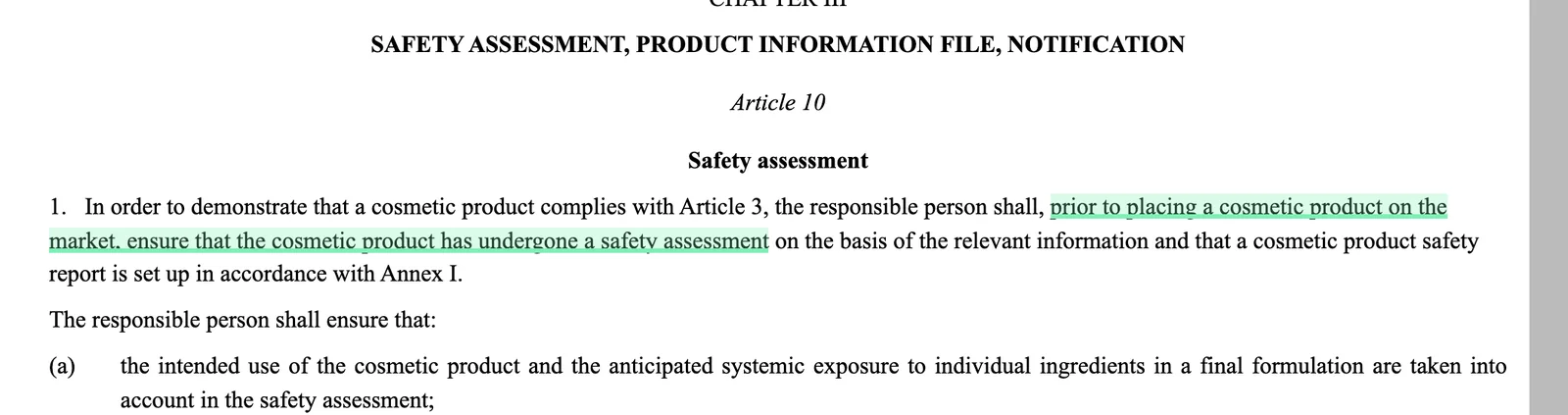
Both regimes also require the CPSR to be kept current: new safety data, a formula tweak or an ingredient status change reopens the document. A CPSR written at launch is not one-and-done.
The change protocol in practice: any formula change, however small, goes back to the assessor before it goes into production. Minor changes within already-assessed limits usually need only a documented delta review and an updated Part B conclusion; a new ingredient or concentration outside the assessed range means new exposure calculations and, where relevant, new testing. The PIF is updated, the CPNP or SCPN record is updated to match, and if the INCI list changed, the label changes with it. Reformulating first and telling the assessor later inverts the legal order of operations.
The requirement covers product types including:
- soaps
- shampoos
- conditioners
- bath bombs
- body butters
- lip balms
- perfume balms
- hair oils
- cleansers
- toners
- serums
What does a CPSR contain? Part A and Part B
Part A without Part B is incomplete; Part B without Part A is unverifiable. Both must sit in the PIF before the first sale. The full input checklist is in our guide to what a CPSR needs from you.
Who can sign a CPSR?
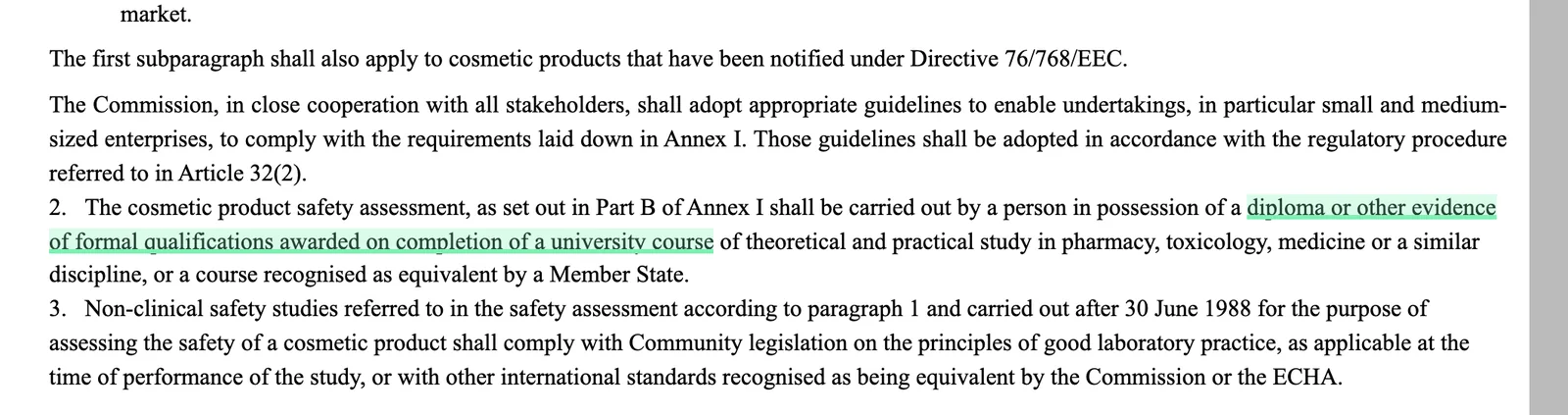
Credentials are the floor, not the bar: regulators also look for demonstrable experience in cosmetic safety assessment. A CPSR signed by an unqualified consultant, or generated by software with no named assessor, does not survive enforcement scrutiny.
When a CPSR fails scrutiny, it fails for predictable reasons. The ones we see first: a Part B with no named, qualified signatory; a Part A formula that does not match the INCI list printed on the artwork (the assessed product and the sold product must be the same product); a water-based formula with no challenge-test data behind the microbiological section; and template toxicological profiles pasted in with no product-specific exposure calculation. Any one of these turns the report from evidence into liability.
The delay is almost never the assessment; it is the data pack. The same three gaps stall most files that reach us: a formula given in ranges instead of exact percentages (Part A needs the real numbers, and so do the exposure calculations), no challenge test on a water-based product (that is a 28-day study you cannot compress), and claim evidence that does not exist for claims already printed on the artwork. Brands that assemble Part A properly get Part B back in days. Brands that send a folder of supplier brochures wait weeks and think the assessor is slow.
How does the CPSR relate to the PIF?
Think of the PIF as the file and the CPSR as the most scrutinised document inside it. An inspector checking compliance opens both.
CPSR for the UK vs the EU: one document or two?
The lists are also diverging: the GB restriction schedule has been amended independently of EU updates since 2024, so an ingredient compliant in one market can be restricted in the other. Treating the two CPSRs as one unchanged document is an accumulating risk, and the ingredient review must run against both lists.
Post-Brexit, a single CPSR drafted to the stricter standard (EU Reg 1223/2009 + UK BPR) is accepted in both markets; CIGREG’s assessors draft to both simultaneously.
For the first years after Brexit, one CPSR quietly served both markets and nobody noticed. That window is closing: since the GB restriction schedule started moving independently in 2024, every EU amendment is a fork, and a file that was compliant on both sides drifts out of date on one of them without anyone touching the formula. This is where running the EU and UK dossiers under one roof pays off: when either list moves, both CPSRs get the delta review at the same time, instead of the UK file being remembered a year later during a retailer audit. If your EU and UK paperwork live with two different providers, ask each of them who is watching the other list. The honest answer is usually nobody.
Can you sell cosmetics from home without a CPSR?
The real consequence of skipping it is not missing paperwork; it is an unassessed product on real skin. When something goes wrong, the legal and reputational exposure lands without the one document that would have defended you.
How long does a CPSR take, and what does it cost?
Market prices range from roughly £55 for the cheapest simple-formula reports to £700+ for complex products, and the cheap end is where unqualified signatures live. Our own CPSR service is fixed at $450 to $600 per product, signed by a qualified assessor, with the timeline stated before any work begins. Full cost drivers are in CPSR cost and timeline.
What happens if you sell without a valid CPSR?
The public record compounds it: a recall notice is visible to every retailer and customer you approach afterwards. The CPSR is the foundation market access rests on; without it there is no foundation.
This is visible enforcement, not a paper threat: the EU’s Safety Gate rapid alert system publishes cosmetics pulled from member-state markets every week, and missing or inadequate safety documentation is a recurring ground, while UK trading standards prosecute under the 2013 Regulations. The pattern in those alerts is small brands and imported products: exactly the sellers who assumed they were too small to be checked.
How to get a CPSR: the five inputs your assessor needs
The five inputs your assessor needs:
- full ingredient list (INCI)
- usage instructions
- manufacturing process
- stability data
- challenge test results
FAQ
Common questions.
Primary sources cited in this guide. Regulatory status last verified 22 August 2026.
- legislation.gov.uk: Regulation (EC) No 1223/2009, Annex I (CPSR structure)
- legislation.gov.uk: Article 10, the safety assessment obligation
- GOV.UK / OPSS: Making cosmetic products available to consumers in Great Britain
- European Commission: Cosmetics legislation overview
- GOV.UK: Cosmetic Products Enforcement Regulations 2013