EU & UK regulatory guide

Responsible Person for cosmetics: EU and UK obligations, explained

Every cosmetic sold in the EU or UK has a Responsible Person legally attached to it: the entity on the label that answers for safety, filings and recalls. Without one, the product cannot be sold.
Appointing a Responsible Person for EU and UK cosmetic compliance
CM
Written and reviewed by Cassandra Maddocks
Chemist & biochemist · cosmetic safety assessor · LinkedIn · last reviewed 22 August 2026
TL;DR: A Responsible Person is the legally designated entity whose name and address appear on every cosmetic sold in the EU or UK, and who guarantees the product’s compliance. The role is mandatory under Article 4 of Regulation (EC) No 1223/2009 and its retained UK equivalent. Since Brexit you need one in each market: an EU RP for the EU, a UK RP for Great Britain. Consequences of selling without one run from forced withdrawal to criminal liability.

What is a Responsible Person in cosmetics?
The legal or natural person, established in the EU or UK, who is named on the product label and takes full regulatory accountability for the product: its safety assessment, labelling, notifications and post-market surveillance. Defined in Article 4 of Regulation (EC) No 1223/2009.
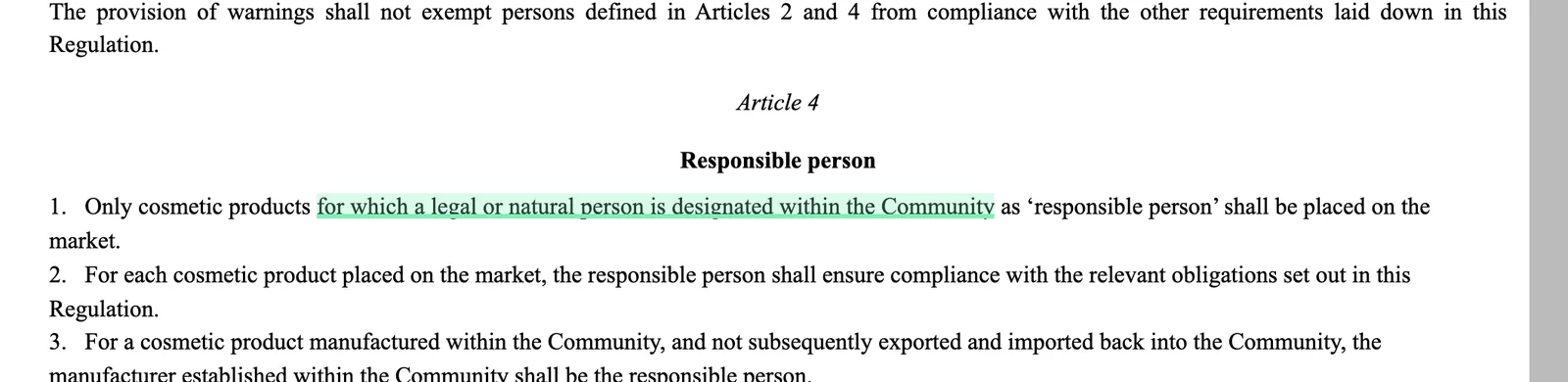
Article 4 of Regulation 1223/2009 on EUR-Lex: only products with a designated responsible person may be placed on the market
Article 4 in the consolidated text of Regulation (EC) No 1223/2009 on EUR-Lex: only a cosmetic product for which a Responsible Person is designated may be placed on the market. From our evidence library.

It is not a title a brand can self-assign loosely. The Responsible Person must be genuinely established, with a real registered address, in the EU to sell in the EU or in the UK to sell in Great Britain. A mail-forwarding address does not qualify. A PO box does not qualify. If a product is recalled, it is the Responsible Person who answers to the competent authority.

Is a Responsible Person legally required?

Yes, with no exceptions. Article 4 of Regulation (EC) No 1223/2009 makes the role mandatory for every product on the EU market; Great Britain applies the same rule through the retained regulation, enforced by OPSS. The designation must exist before the product is placed on the market.

One EU Responsible Person covers all 27 member states. One UK Responsible Person covers England, Scotland and Wales. You cannot notify, label or sell first and appoint later: the requirement is pre-market.

What are the Responsible Person’s obligations?

Seven active duties: commission and maintain the CPSR, compile and keep the Product Information File for 10 years after the last batch, notify pre-market (CPNP for the EU, SCPN for GB), ensure compliant labelling, run post-market surveillance, report serious undesirable effects, and take corrective action when something is wrong.

Each duty is ongoing, not one-time. A reformulation, a label change or a change of RP details triggers updates to the PIF and the notification. The label must carry the RP’s name and address, the INCI list, batch number, nominal content, PAO or best-before date, and any required warnings.

Who can be the Responsible Person?

A hierarchy set by the regulation: the manufacturer (domestic production), the importer (product made outside the jurisdiction), a distributor (only if selling under its own name or modifying the product), or any established third party appointed by written mandate. The third-party route is how most international brands do it.

The importer-default is the trap that catches marketplace sellers: ship stock into the EU without designating anyone, and whoever imports it becomes the Responsible Person by law, whether they know it or not. Fulfilment providers and freight forwarders do not want that role and are not equipped to hold it, which is why authorities checking marketplace listings look for exactly this gap.

The written mandate is not decorative. To stand up in an inspection it must name the parties, state that the designated entity accepts the RP role and its obligations, be signed by both sides, and match the name and address printed on the label. An email agreement is not a mandate.

My take, from practice

When we take over as Responsible Person for a brand that was “already compliant”, the same two gaps surface again and again. First, the label names an address that is not actually the RP: the brand’s home-country office, a fulfilment warehouse, or a mail-forwarding service with no one behind it who could hand a Product Information File to an inspector within the required timeframe. Second, the written mandate is missing: someone agreed to “be the RP” in an email thread, which is not a designation under Article 4. Established means someone at that address can produce the PIF and answer the authority; if your RP cannot do that, you do not have one.

EU vs UK Responsible Person: what changed after Brexit?
One EU-established RP covered both markets until 1 January 2021. Now they are separate jurisdictions: an EU RP notifying via the CPNP, and a UK RP notifying via the SCPN under OPSS guidance, with the UK RP’s name mandatory on GB packaging since 31 December 2022. Northern Ireland stays on EU rules.
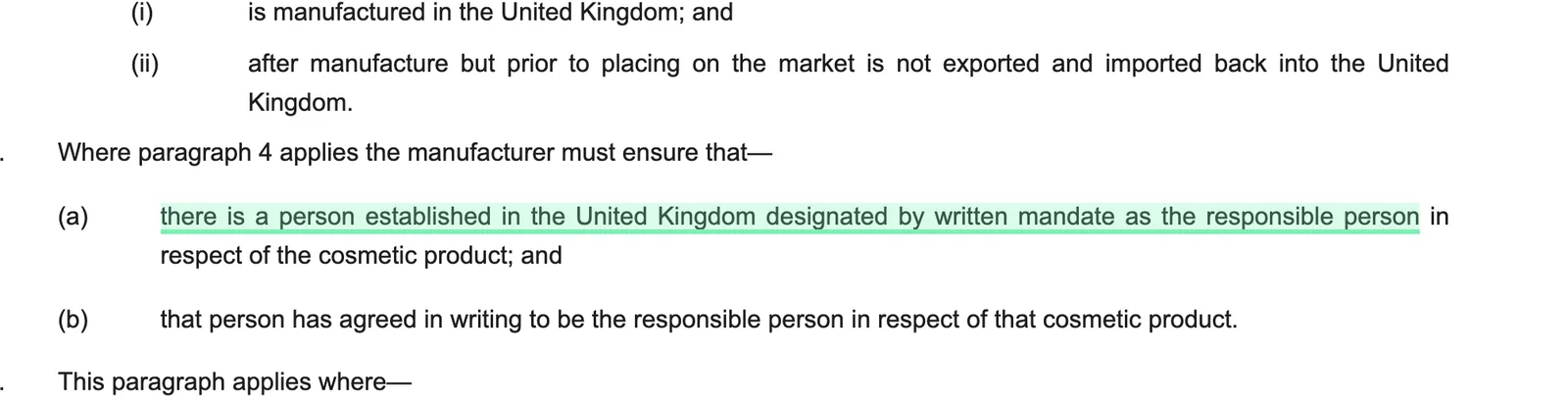
Retained Article 4 on legislation.gov.uk establishing the UK responsible person requirement for Great Britain
The same Article 4 as retained in Great Britain, on legislation.gov.uk: a separate, UK-established Responsible Person requirement enforced by OPSS.

Selling in both markets means two RPs, two notifications and two label blocks. The efficient route is one partner holding both roles, which is the pairing of our EU and UK Responsible Person services. If you are changing an existing arrangement, the sequence matters: see switching your EU Responsible Person.

Can you sell cosmetics from home in the UK without a Responsible Person?

No. Scale is irrelevant. A sole trader making lip balms in a kitchen and a brand importing from Korea face the identical rule: a UK-established RP before the first unit sells, whether at a market stall, on Etsy or through a retail chain.

Make the product yourself and sell under your own name, and you are the manufacturer and the default RP: the CPSR, the PIF, the SCPN notification and compliant labelling all fall on you. You can move the accountability to a third-party UK entity by written mandate, but the CPSR and PIF are non-negotiable either way. There is no cosmetics seller licence in the UK; the absence of a licence is not the absence of legal requirements.

How to appoint a Responsible Person

Six steps: confirm the jurisdictions you sell in, identify your default position, execute a written mandate signed by both parties, complete the PIF with a signed CPSR, submit the CPNP or SCPN notification, and keep the records current from then on.

When selecting a third-party RP, check four things: genuine establishment in the jurisdiction (not just registration), access to qualified safety assessors, professional indemnity insurance, and a defined process for serious-undesirable-effect reports and corrective action. A provider who quotes only the designation and excludes the safety assessment or notification is quoting a fraction of the job.

What happens if you don’t have a Responsible Person?

Mandatory withdrawal from the market, recall of stock already sold, legal liability defaulting to whoever placed the product on the market, failed retailer onboarding, and months of lost market access. In the UK, enforcement under the Cosmetic Products Enforcement Regulations 2013 can be criminal.

Authorities do not need to prove harm: the missing designation is itself sufficient grounds, and the label tells the story. Major retailers run the same check in supplier onboarding; no RP, no listing.

FAQ

Common questions.

The legally designated entity, a business or individual established in the EU or UK, whose name and address appear on the product label and who takes full regulatory accountability for the product’s safety, labelling and compliance. Defined in Article 4 of Regulation (EC) No 1223/2009 and its UK equivalent.

Yes, without exception. Every cosmetic placed on the EU market needs an EU-established Responsible Person before it goes on sale. Brands based outside the EU must appoint an EU-established entity to hold the role.

Yes, if you are established in the target market. A UK brand selling in Great Britain, or an EU manufacturer selling in the EU, is the RP by default. If you are not established there, you must appoint a third party.

Commissions and maintains the CPSR, keeps the Product Information File, submits the CPNP or SCPN notification, ensures compliant labelling, runs post-market surveillance and reports serious undesirable effects. Active and ongoing, not a one-time designation.

Models vary: per product, annual retainer, or bundled with the safety assessment and PIF. Transparent fixed pricing per product and per jurisdiction is the clearest to evaluate. Be cautious of quotes that cover only the designation and exclude the safety assessment or notifications.

Yes. Since 1 January 2021 they are separate jurisdictions: an EU-established RP for EU sales, a UK-established RP for Great Britain. Northern Ireland follows EU rules. One partner holding both roles removes the duplication.

Need a Responsible Person in the EU, the UK, or both?
One partner, both jurisdictions, fixed pricing. Signed mandate, PIF hosting and notifications included.
Get a quote