A challenge test proves your preservative system can kill what a consumer introduces every time they dip a finger in the jar. It runs to ISO 11930 over 28 days, and it is the difference between a product that stays safe in a bathroom and one that grows mould by week three. Here is how it works.
Reviewed by Cassandra Maddocks, chemist & biochemist · last reviewed 28 July 2026
What is a challenge test?
A preservative efficacy test: the product is deliberately inoculated with known microorganisms, then sampled over time to see whether the preservative system reduces and controls them. It proves the product will resist the contamination a user introduces during normal use, which enumeration testing of a fresh sample cannot show.
It is also called preservative efficacy testing or PET. The standard method is ISO 11930, which evaluates the overall antimicrobial protection of a cosmetic product.
Which organisms are used, and over how many days?
Five reference strains are inoculated: the bacteria Pseudomonas aeruginosa, Staphylococcus aureus and Escherichia coli, the yeast Candida albicans and the mould Aspergillus brasiliensis. The product is sampled on days 7, 14 and 28 (and often day 2) to track how quickly each population falls.
The 28-day run is why a challenge test cannot be rushed: the time is the data. It sets up in a day but reports four weeks later, so it is planned alongside, not after, the rest of the file.
What are Criteria A and B?
ISO 11930 grades a result against two thresholds. Criterion A is the higher bar, a strong, fast log reduction that shows the preservative system protects the product on its own. Criterion B is a lower bar, acceptable only when combined with protective packaging or formulation factors assessed as reducing risk. A product must meet A, or meet B with a documented risk assessment.
The log-reduction targets differ by organism and time point; bacteria are expected to fall faster and further than fungi. A borderline B result is where the assessor's judgment matters, and where the risk assessment under ISO 29621 for low-risk products comes in.
Does every product need a challenge test?
Water-containing products almost always do, because they can support microbial growth. A product the assessor scientifically justifies as low risk, an anhydrous oil or balm, an extreme pH, a single-use unit, may omit it. That justification is documented by the assessor, not assumed by the brand.
Claiming a waiver without a written justification is a classic inspection finding. Whether your product qualifies is exactly the kind of question to settle at the inputs stage, before you pay for a test you may not need.
How is it different from microbiology testing?
Microbiology testing asks whether the product is clean when it leaves the factory. The challenge test asks whether it stays clean while a consumer uses it for months. One is a snapshot of the finished batch, the other is a stress test of the preservative system over time. Both usually sit in the file.
The distinction matters because passing one says nothing about the other, as our microbiology testing guide explains. A product can be spotless on day one and fail a challenge test by day 14.
What happens if it fails?
A failed challenge test means the preservative system is inadequate, and the formula must change: a different preservative, a higher permitted level, or a packaging change that reduces exposure. It is a formulation problem, not a paperwork one, and it is far cheaper to find in the lab than after launch.
This is the strongest argument for scoping testing properly up front. CIGREG maps which tests your product needs, coordinates the challenge test with accredited labs, and folds the result into a signed CPSR. If a reformulation is needed, you learn it early: request a quote.
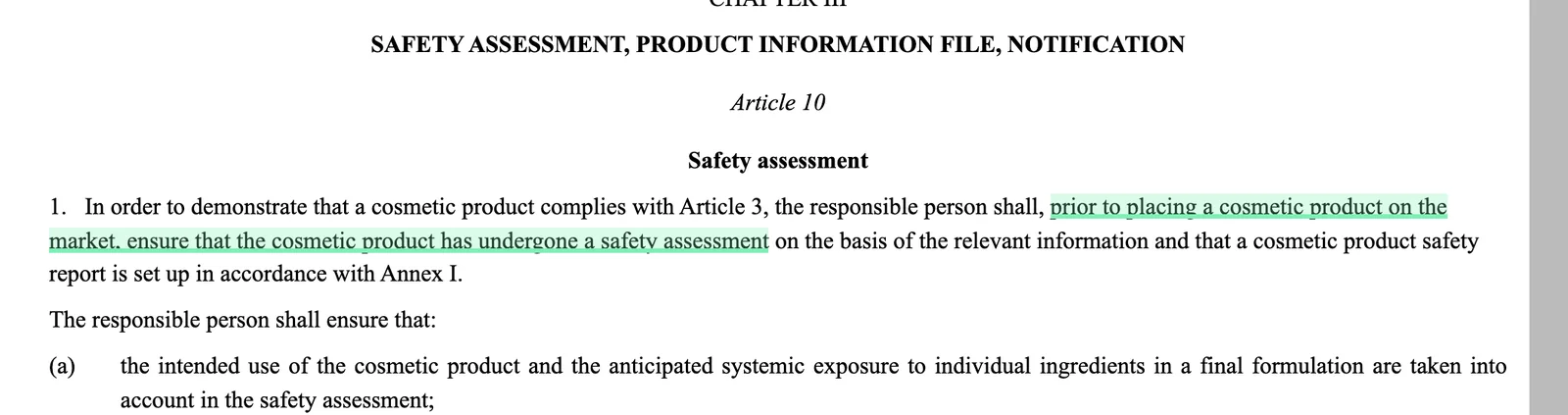
Article 10(1) of Regulation (EC) No 1223/2009, the safety assessment your challenge result supports, as published on EUR-Lex, consolidation of 1 May 2026 (02009R1223, EN, 040.001). Captured 26 July 2026. View the official text.
What are the log-reduction targets?
ISO 11930 sets minimum reductions in the inoculated population at each sampling day, and the targets differ by organism: bacteria are expected to fall faster and further than yeast and mould. A result is graded against two thresholds, Criterion A and Criterion B, rather than a single pass mark, which is what makes challenge results a matter of interpretation rather than a simple yes or no.
ISO 11930 criteria, in outline
Criterion
What it means
When it applies
Criterion A
Strong, fast log reduction; the preservative system protects the product on its own
The standard pass; no further justification needed
Criterion B
A lower reduction, acceptable only with supporting factors
Allowed when packaging or formulation is assessed as reducing risk
Fail
Reduction below Criterion B at the required time points
The preservative system is inadequate; reformulate
How is the inoculum prepared?
Each reference strain is grown to a defined concentration and introduced into a separate portion of the product, so every organism is tested against the preservative system independently. The lab then samples on days 2, 7, 14 and 28 and counts the survivors, tracking how quickly each population collapses or, in a failing product, persists.
The 28-day run cannot be compressed: the elapsed time is the measurement, which is why a challenge test is planned alongside the file, not after it.
What is ISO 29621 and a low-risk product?
ISO 29621 sets out how to assess whether a product is microbiologically low risk, for example an anhydrous formula, an extreme pH, a high alcohol content or an airless single-use pack. A product justified as low risk under ISO 29621 may meet Criterion B, or in some cases omit the challenge test entirely, but that judgement is the assessor's to document, not the brand's to assume.
Does natural preservation pass a challenge test?
Sometimes, and it has to be proven, not claimed. Natural and preservative-free systems can pass ISO 11930, but they are more likely to land on Criterion B or to fail outright, which is exactly why the test exists. A brand marketing a preservative-free position needs the challenge data to back it, or the claim and the safety file are both exposed.
Sources
Primary sources cited in this guide. Regulatory status last verified 28 July 2026.