Stability testing proves a product stays safe, effective and unchanged across its shelf life, and it is the reason a launch timeline is measured in months rather than weeks. It is also the test brands most often start too late. Here is what it involves, how long it takes, and why the calendar belongs to it.
Reviewed by Cassandra Maddocks, chemist & biochemist · last reviewed 28 July 2026
What is stability testing?
A study that stores a product under controlled conditions and monitors it over time to confirm it stays physically, chemically and microbiologically stable across its intended shelf life. It supports the durability date or period-after-opening on the label and gives the safety assessor evidence the product will not degrade into something unsafe.
Cosmetics have no single mandated stability protocol; instead the safety report under Annex I of Regulation (EC) No 1223/2009 requires adequate stability data, and ISO 22716 GMP frames how it is documented. The assessor decides what evidence is adequate for each product.
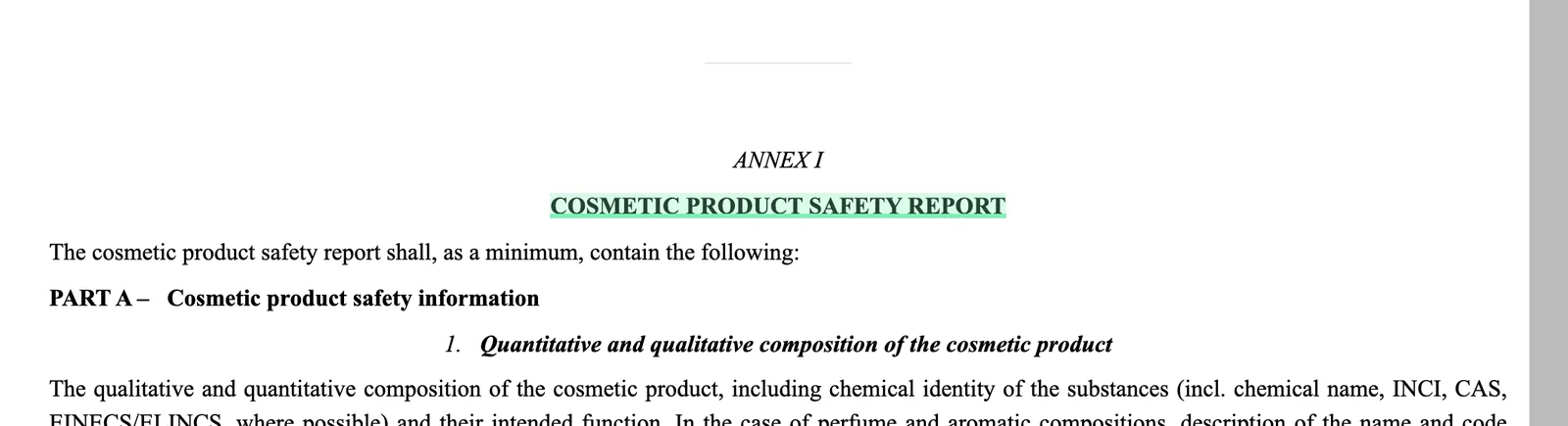
Annex I of Regulation (EC) No 1223/2009, the safety report structure these test results feed, as published on EUR-Lex, consolidation of 1 May 2026 (02009R1223, EN, 040.001). Captured 26 July 2026. View the official text.
What is accelerated stability testing?
Storing the product at an elevated temperature, commonly around 40 to 45C, to speed up the ageing process so months of shelf life can be estimated in weeks. A standard accelerated study runs about three months; roughly three months at 45C is often taken as a proxy for a longer real-time shelf life, with the assessor interpreting the result.
Accelerated testing is an estimate, not a guarantee. It is usually paired with real-time studies at ambient temperature that continue in the background and confirm the accelerated prediction over the product's actual claimed life.
What conditions and parameters are tested?
Products are held at a range of temperatures, typically an elevated incubator, room temperature and a low temperature around 4 to 5C, and often put through freeze-thaw cycling and centrifugation to mimic transport stress. At each checkpoint the lab records pH, viscosity, colour, odour, appearance and any phase separation, plus microbiological quality.
A product passes when those parameters stay within defined tolerances over the study, so it looks, feels, performs and preserves the same at the end as at the start. Any drift, a colour shift, a separating emulsion, a falling pH, flags a reformulation before the market does.
How long does stability testing take?
This is the long pole in a cosmetic launch. An accelerated study is around three months; a full real-time study can run 6 to 12 months to cover the claimed shelf life. Nobody can compress it, because the elapsed time is the measurement, which is why stability, not paperwork, sets the launch calendar.
The practical rule is to start stability during product development, not after everything else is ready. Brands that wait until the formula is final and the branding done routinely lose three months they did not need to, as our CPSR timeline guide explains.
How does stability relate to the PAO and shelf life on the label?
Directly. The period-after-opening symbol, the jar with a number of months, and any best-before date must be supported by stability data. You cannot label a 12-month PAO without evidence the product is stable and safe for twelve months after opening; the study is what earns the number on the pack.
This links stability to the label rules covered in our label requirements guide. An unsupported durability claim is both a stability gap and a labelling one.
Can I reuse stability data across markets?
Yes. A stability study done for the EU serves the UK and Swiss files and feeds US safety substantiation under MoCRA. The physics of the product does not change at a border, so the data travels even though the responsible-person structure does not. This is why second markets cost a fraction of the first.
CIGREG scopes exactly which stability protocol your product needs, coordinates the study with accredited laboratories, and builds the results into a signed CPSR that serves every market you enter. Start early and tell us your launch date: request a quote.
What is freeze-thaw cycling?
A physical stress test that repeatedly freezes and thaws the product to mimic the temperature swings of shipping and storage. Emulsions are especially vulnerable: a cream that survives steady-state storage can separate irreversibly after a few freeze-thaw cycles, so the test surfaces a weakness the label would otherwise hide until a winter delivery.
Typical stability storage conditions
Condition
What it simulates
Typical duration
Around 40 to 45C
Accelerated ageing; heat and sea-freight
About 3 months
Room temperature
Real-time shelf life
6 to 12 months
Around 4 to 5C
Cold-chain and air-freight; low-temperature stress
Alongside the study
Freeze-thaw cycling
Repeated temperature swings in transport
Several cycles
Centrifugation
Emulsion stability under physical stress
Short, early screen
Light exposure
Photostability of colour and actives
Where relevant
What is centrifugation and photostability testing?
Centrifugation spins the product at speed to force any tendency to separate to the surface quickly, a fast early screen for emulsion stability before the longer study runs. Photostability testing exposes the product to light to check that colour and light-sensitive actives hold up, which matters for clear packaging and for formulas built around vitamin C or similar ingredients.
Each checkpoint records pH, viscosity, colour, odour, appearance and microbiological quality; a drift in any one flags a reformulation before the market does.
How do I set the PAO or best-before date?
The durability marking on the pack, the period-after-opening jar symbol or a best-before date, must be earned by the stability study, not chosen for marketing. A twelve-month period-after-opening needs evidence the product stays safe and stable for twelve months after opening; claiming a number the data does not support is both a stability gap and a labelling breach.
Does stability data reuse across markets?
Yes. The physics of the product does not change at a border, so a stability study built for the EU serves the UK and Swiss files and feeds US safety substantiation under MoCRA. This is the main reason a brand's second market costs a fraction of its first: the responsible-person structure has to be rebuilt per market, but the lab data travels with the product.
Sources
Primary sources cited in this guide. Regulatory status last verified 28 July 2026.
It sets your launch calendar, so it should start during development. We scope the study, coordinate the lab, and build the result into a signed safety report.