Multi-market guide
Cosmetic label requirements by market.
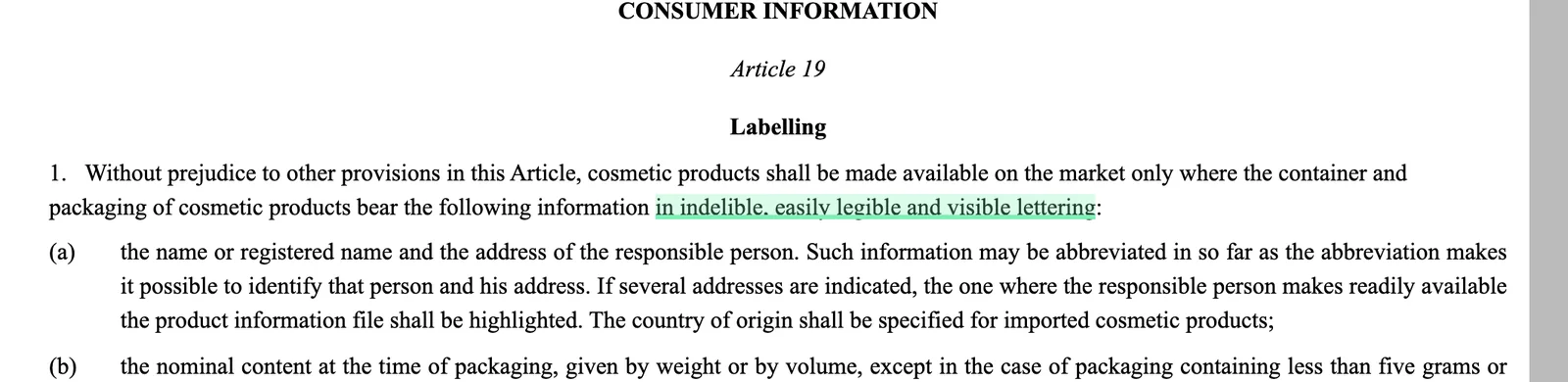
The label is the first thing an inspector reads and the cheapest thing to get wrong. Here is what must appear on a cosmetic label in the EU, the UK, Switzerland and the US, and where the four markets quietly differ.

Reviewed by Cassandra Maddocks, chemist & biochemist · last reviewed 26 July 2026
What must appear on a cosmetic label?
Labelling is one duty among eight: see the full EU compliance map.
| EU | UK (GB) | Switzerland | US | |
|---|---|---|---|---|
| Legal basis | Article 19, Reg. 1223/2009 | UK Cosmetics Regulation (retained law) | VKos (Swiss Cosmetics Ordinance) | FDCA, FPLA and MoCRA |
| Name & address shown | EU Responsible Person | UK Responsible Person (a UK address) | The Swiss or EU/EEA responsible firm | Manufacturer, packer or distributor |
| Ingredient list | INCI, descending order, "ingredients" | INCI, same convention as the EU | INCI, aligned with the EU | Ingredient declaration per FDA labeling rules |
| Language of warnings | Language(s) set by each member state | English | At least one of German, French or Italian | English |
| Durability marking | Best-before or PAO symbol | Best-before or PAO, as in the EU | Best-before or PAO, aligned with the EU | No PAO regime; expiry where relevant |
| Distinct extra | Country of origin for imports | Separate GB label if RP differs from EU | Swiss-language warnings are the usual redesign trigger | Adverse-event contact required since 29 Dec 2024 |
Primary texts: Article 19 of Regulation (EC) No 1223/2009 for the EU, GOV.UK guidance for Great Britain, the Swiss Cosmetics Ordinance, and FDA cosmetics labeling rules plus MoCRA for the US.
What does the EU require on the label?
The address on the pack must be the EU Responsible Person's, not the brand's head office, which is why appointing or changing your EU setup usually means a label revision.
Some ingredients also trigger mandatory label warnings from their annex entries, retinol’s Vitamin A notice among them; the rules for what you may claim beside them are in our claims guide; see our ingredient rules guide for the entries themselves.
How is a UK label different from an EU label?
The details sit in our UK Responsible Person guide; the underlying rules are in the retained UK cosmetics legislation.
Why do Swiss labels trip up EU-compliant brands?
Our Switzerland market page covers the self-monitoring regime the label sits inside.
What did MoCRA change on US labels?
The in-force duties are summarised on the FDA's MoCRA page; our MoCRA guide separates what is enforceable now from what is still pending.
Can one label work for all four markets?
That check is exactly what our label compliance review does: $300 per product, against each target market's current rules, before you commit to a print run. Request a label review.
Primary sources cited in this guide. Regulatory status last verified 26 July 2026.
Related reading