EU regulatory guide
The Product Information File, explained.
The PIF is the complete technical dossier behind every cosmetic product on the EU market: defined by Article 11, held by your Responsible Person, and kept for ten years after the last batch. This guide covers what goes in it, where it lives, and how long it must survive.
Reviewed by Cassandra Maddocks, chemist & biochemist · last reviewed 26 July 2026
What is the Product Information File?
New to the dossier itself? Start with What is a PIF?, our plain-language explainer.
The PIF is not filed anywhere: unlike the CPNP notification, nobody receives a copy. It sits at your Responsible Person's address, ready for inspection, for the entire life of the product and a decade beyond.
What must the PIF contain?
The heart of the file is the CPSR (its inputs are covered in our CPSR inputs guide), the safety assessment signed by a qualified assessor. The GMP statement is normally evidenced against ISO 22716, the international GMP standard for cosmetics. Claim evidence is the piece brands most often underestimate: a "clinically proven" on the label needs its proof in the file.
Where must the PIF be kept?
That address requirement is why the PIF and the Responsible Person appointment are inseparable: whoever holds the role physically anchors the file. The full picture of the role is in our EU Responsible Person requirements guide.
How long must the PIF be kept?
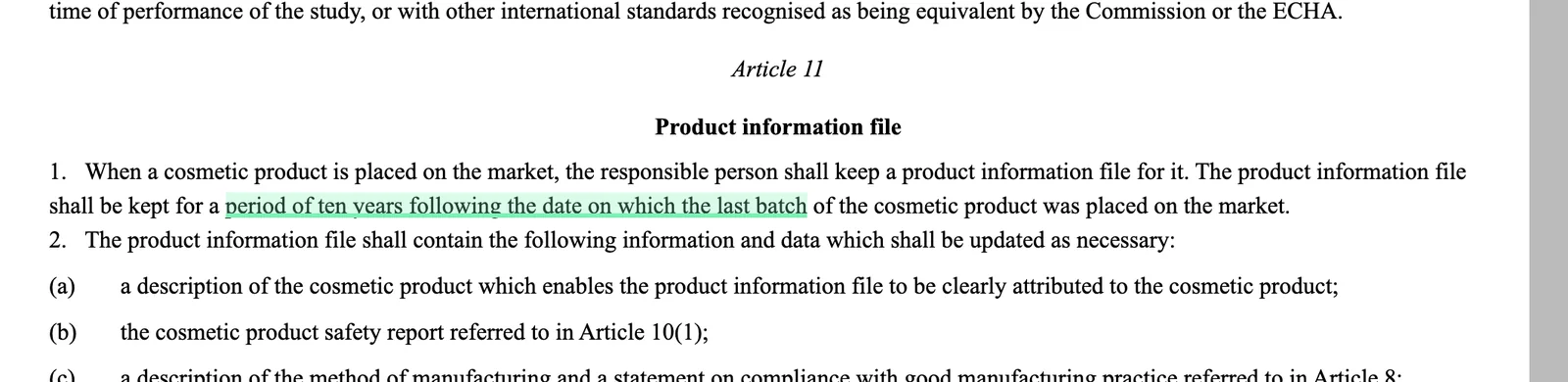
This is the timescale that makes dossier quality a governance question rather than a paperwork one: the person who assembled the file may be long gone when an authority asks for it. How CIGREG keeps files defensible over that span is described on our governance page.
What is the difference between the PIF and the CPSR?
Brands often use the terms interchangeably and order the wrong deliverable. The sequence runs: CPSR first, then the PIF assembled around it, then the notification filed once the file is complete. The full side-by-side (who produces each document, who sees it, and what each costs) is in our CPSR vs PIF vs notification comparison.
Do the UK and Switzerland need a PIF too?
One well-built dossier travels: the same core documents, adapted per market, satisfy all three regimes. That reuse is the practical reason to build the EU file properly first. See the UK guide and the Swiss guide for the market-specific holders.
When does the PIF need updating?
An out-of-date PIF is one of the most common findings in market-surveillance checks: the product evolved and the file did not. Keeping dossiers current across markets is the recurring work of Compliance Care.
What does a PIF cost to build?
Full prices and worked examples are on the pricing page.
Primary sources cited in this guide. Regulatory status last verified 26 July 2026.
Put this into practice
From reading to a market-ready file.
FAQ