EU regulatory guide
Private label: whose compliance is it.
Reviewed by Cassandra Maddocks, chemist & biochemist · last reviewed 22 August 2026
A purchase order that names the filling site as manufacturer is a commercial line, not a legal transfer. Article 2(1)(d) asks who had the product designed or manufactured and who markets it under their name or trademark. If that is your brand, you are the manufacturer, even when every kettle, filler and carton line sits at a third-party site.
CIGREG is the regulatory partner on that file. We are not the lab, and we do not take over manufacturing. The site remains a subcontractor. The brand remains the manufacturer. Mixing those roles is how private-label launches ship with the factory named in the wrong legal box.
Who is the manufacturer under Article 2(1)(d)?

Article 2(1)(d) defines the manufacturer as any natural or legal person who manufactures a cosmetic product or has such a product designed or manufactured, and markets that cosmetic product under his name or trademark. Having it designed or made for you, then selling it under your name, is manufacturing in this regulation. The site that only fills to your brief is a subcontractor. The neighbouring definitions matter when you are not rebranding: a distributor under Article 2(1)(e) is anyone in the supply chain other than the manufacturer or the importer who makes the product available, and an importer under Article 2(1)(i) is the Community-established person who places a third-country product on the market. The map of those roles is in EU cosmetic regulations.
Did hiring a lab transfer manufacturer status?
The commercial document can name the filler, allocate batch records, and set a price per unit. It cannot move the legal face of the product. If your name or trademark is on the pack and you commissioned the design or the fill, you are the manufacturer. The lab stays a subcontractor even when the invoice says otherwise.
How does manufacturer status differ from the Responsible Person?
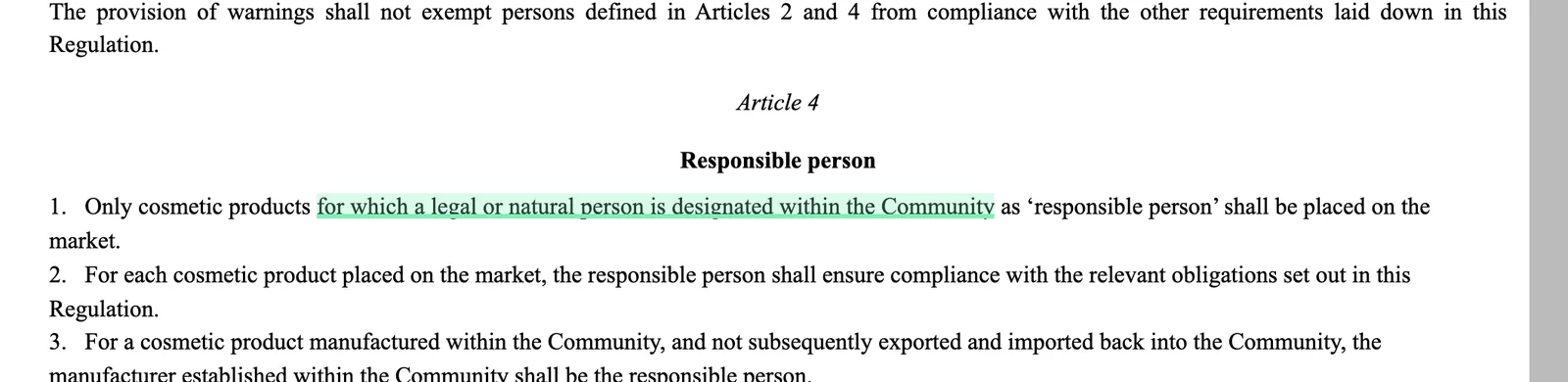
Article 4(3) makes an EU-established manufacturer the default Responsible Person unless a written mandate appoints someone else. Article 4(5) does the same for the importer of a third-country product. Article 4(6) steps a distributor into the role when that distributor places the product on the market under its own name or trademark, or modifies it in a way that may affect compliance. The second paragraph of Article 4(6) is the trap people miss: translation of information relating to a product already placed on the market is not such a modification. Appointing an EU Responsible Person by written mandate is how a non-EU brand gets a Community RP. It does not stop that brand being the manufacturer under Article 2(1)(d).
What files must exist before placing on the market?
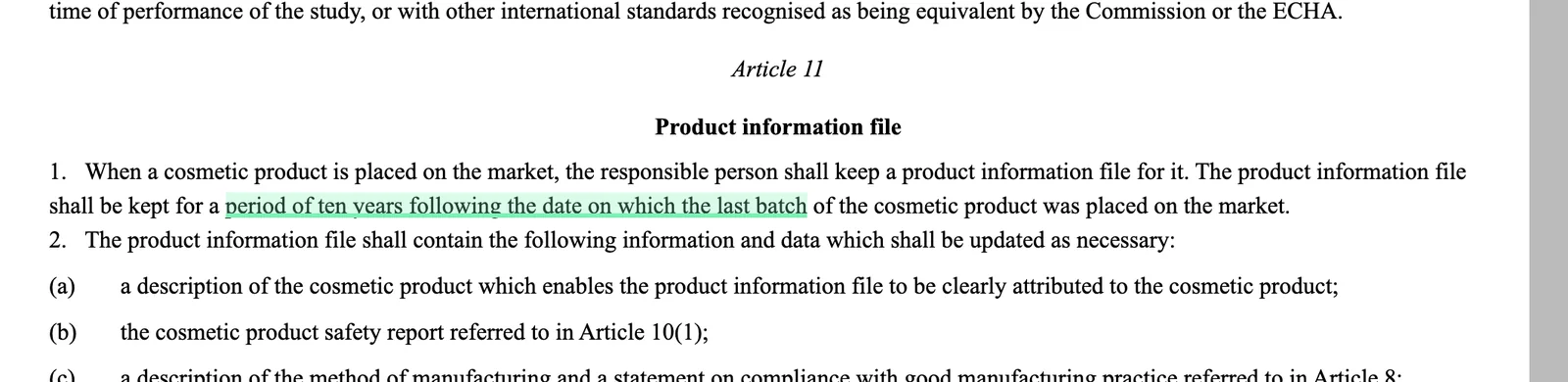
The factory file is built for the factory’s product, label and claims. Yours are different, so the file must be rebuilt for your brand. Ask the site for formula percentages, raw-material data, GMP evidence and existing tests, then commission a product-specific CPSR, hold a PIF for ten years after the last batch, and complete CPNP before first sale. A cooperative lab shortens the assessment. It does not finish it.
Does GMP sit with the site or the brand?
The site should be able to show how the batch was made and controlled. The PIF is where that method and the GMP statement live, at the Responsible Person’s address. ISO 22716 is the usual way to demonstrate the Article 8 duty. Treating the certificate as belonging only to the filler, and leaving nothing in the brand file, is how an inspection finds a hole.
How do GB, CH, US treat the same split?


GB keeps the same manufacturer reading and a separate UK RP plus SCPN filing; the retained text is on legislation.gov.uk, and the working guidance is GOV.UK on making cosmetics available in Great Britain. Switzerland is not a second CPNP: hold a separate file and a Swiss-territory address. That file is not an EU PIF by another name. The Swiss manufacturer reading sits in VKos Art. 2 Abs. 1 Bst. c, not letter d. In the US, the name on the label is typically the Responsible Person under FD&C Act section 604(4) / 21 U.S.C. 364(4). Facility registration is the manufacturing or processing site. FDA Media 190681 restates that split; the PDF is often bot-walled, so treat the statute as the working text, not a screenshot of the guidance.
What are the common private-label mistakes?
The invoice names a supplier. It does not transfer manufacturer status. The factory CPSR and PIF describe the factory’s product, not yours. Leaving the RP at the filling site ties market access to that commercial relationship and, for an EU-made product, can leave the default Article 4(3) role with the site if no written mandate exists. CPNP is the last filing, not the file. A US label name is a MoCRA Responsible Person under FD&C 604(4). It is not a Community RP.
The competent authority chases the manufacturer. Under Article 2(1)(d) that is the brand that has the product made and markets it under its name, not the lab. The lab is a subcontractor. That is why the client needs a strong commercial contract with the lab: the law is not looking through the brand to the filler. It is looking at the face on the pack.
What to lock before the first EU or UK batch?
Do this before the first batch, not after the first shipment. Confirm in writing that your brand is the Article 2(1)(d) manufacturer and that the site is a subcontractor. Appoint the Community RP by written mandate so the role does not default to the filler. Build the CPSR and PIF for your label. Notify on CPNP, and on SCPN if Great Britain is in scope. Then fill.
FAQ
Common questions.
Primary sources cited in this guide. Regulatory status last verified 22 August 2026.
- EUR-Lex: Regulation (EC) No 1223/2009, consolidated text (CELEX 02009R1223-20260501)
- legislation.gov.uk: Regulation (EC) No 1223/2009 as retained in UK law
- GOV.UK: Making cosmetic products available to consumers in Great Britain
- European Commission: Cosmetics sector legislation
- Fedlex: Verordnung des EDI über kosmetische Mittel (VKos), SR 817.023.31
- FDA: Registration and Listing of Cosmetic Product Facilities and Products
Related reading